
5-Ton Dual-Axle Hydraulic Lifting Trailer from China: How to Choose a Reliable Supplier
2026-07-24
Sourcing a 5-ton dual-axle hydraulic lifting trailer from China isn’t just about finding the lowest price—it’s about uncovering a supplier that won’t leave you stranded with hidden flaws or zero support. Too many buyers learn this the hard way. At Whole Chain Tech, we’ve seen where the breakdowns happen, and we know the questions that separate trustworthy factories from the rest. In this post, we’re laying out the practical steps you should take before placing an order, so you can skip the trial and error and move forward with confidence.
Hidden Manufacturing Hotspots That Shape Trailer Quality
Not every trailer leaves the factory floor with the same story baked into its frame. Behind the glossy finish and spec sheets, there are obscure stations on the assembly line where real durability is either forged or fatally compromised. One of those is the weld seam treatment area. Here, robotic arms might lay down perfect beads, but it’s the post-weld cooling rate and the manual grinding that follow which determine stress crack resistance over thousands of miles. Rushing this stage leaves micro-fractures that can turn a routine haul into a roadside breakdown. The shops that get it right often have old-school veterans pairing ultrasonic testing with a feel for the metal that no scanner fully replaces.
Further down the line, the axles and suspension alignment bay rarely makes it into marketing footage, yet it’s where geometry can make or break tire life. Laser-guided rigs now align components to fractions of a degree, but the hidden factor is the fixture that holds the chassis—if it isn’t calibrated for thermal expansion from the morning’s welding, the entire assembly can be off. Some builders add a secondary check after the trailer has sat overnight, letting the steel relax into its natural state. It’s a slow, unglamorous step that separates trailers tracking straight from those that eat through rubber like clockwork.
The last secret corner is the paint curing tunnel. Temperature logs are the tell—they show whether the powder coat was truly baked into a molecular bond or merely surface-dried for speed. In the best facilities, probes record data across multiple zones, adjusting airflow to compensate for dense steel sections that act as heat sinks. A trailer that skimps here might look identical on day one, but within a season, you’ll see corrosion fingering out from the joints, a silent signature of a process pushed too fast.
Decoding Supplier Certifications Without the Jargon
Supplier certifications often read like a secret language, full of acronyms and vague promises. The good news? You don’t need to be an industry insider to figure out what’s actually meaningful. Instead of getting lost in the alphabet soup, focus on what each certification actually verifies—whether it’s about ethical labor, material safety, or environmental practices. A simple question like “What does this certificate actually check?” can cut through most of the fog.
Many certifications fall into a few clear buckets. Some confirm that the factory treats workers fairly, others verify that materials are genuinely organic or recycled, and a growing number address carbon footprint or water usage. When you spot a label like GOTS or BSCI, it’s just shorthand for a set of rules the supplier agreed to follow—and is regularly audited against. If the certification body doesn’t publish its audit criteria, treat it as a half-told story.
At the end of the day, a certificate is only as strong as the verification backing it. Look for signs that the supplier’s claims are checked by an outside party, not just self-reported. A quick glance at the certifier’s website should tell you how often audits happen and what exactly they examine. You don’t need to master the jargon—just enough curiosity to ask whether the paper matches the practice.
Custom Modifications That Fit Your Exact Workflow
When integrations feel rigid, our approach turns them into flexible extensions of your daily operations. We study how your team actually works—not just the documented process—then mold the functionality around those real-world patterns. This means prioritizing the gestures and shortcuts that matter most in your specific context, so the system bends to your rhythm instead of forcing you into a foreign routine.
Our modification strategy treats your workflow as a living blueprint. Instead of off-the-shelf fixes that only solve surface issues, we deep-link behaviors across tools, trim unnecessary steps, and surface the precise data each role needs at the moment they need it. The result is a subtly customized environment where friction dissolves because every interaction aligns with the way you naturally think and operate.
After-Sales Support That Outlasts the Warranty
Warranties often come with expiration dates, but our commitment to your success doesn't fade when the paperwork says it's over. We believe genuine support shouldn't be boxed in by arbitrary timelines—your questions still deserve thoughtful answers, your equipment still deserves attentive care, and you still deserve a team that picks up the phone well past the standard coverage window.
From troubleshooting years-old installations to guiding you through unexpected operational hiccups, our specialists stay accessible without handing you off to automated queues or outsourced call centers. We've even assisted clients with custom adaptations long after initial purchase, because real partnerships aren't transactional—they evolve with your needs.
This isn't about extending a service contract; it's about standing behind what we build. When you choose us, you're not just buying a product with a finite guarantee. You're gaining a long-term ally who measures our reputation by how reliably we show up when it matters most, regardless of what the calendar says.
Real-World Feedback From Dealers and End Users
Dealers have been quick to point out that the product “practically sells itself.” One distributor in the Midwest mentioned restocking three times in a single month because demand kept catching him off guard. Another noted that after adding our line to his showroom, walk-in traffic jumped noticeably—customers would come in asking for it by name after seeing it on a job site.
End users tend to focus on how the tool holds up under daily abuse. We heard from a contractor in Texas who accidentally left his unit out in a thunderstorm only to find it working flawlessly the next morning. A landscaper in Oregon said the improved grip design reduced hand fatigue so much that his crew “fought over who got to use it first.”
One story that sticks with us came from a small engine repair shop. The owner started recommending our product to clients dealing with stubborn, rusted bolts. Weeks later, they came back telling him it made their work “almost too easy.” He now keeps a demo unit behind the counter—not to sell, just to prove a point.
Spotting Red Flags Before You Place an Order
Pressing “buy” can feel like a rush—until the package arrives and you realize you missed the warning signs. Those too-good-to-be-true prices often mask shoddy materials or non-existent customer support. If the product images look like generic stock photos with no real-life shots, it’s probably a dropshipped item being sold at a markup. Always zoom in on the details: blurry logos, odd proportions, or features that seem slightly off point to a counterfeit.
Check how the seller responds to questions. Vague, copy-paste answers or outright avoidance signal a storefront that won’t treat your post-purchase issues any better. Reviews deserve more than a quick star-glance—read between the lines. Clusters of five-star ratings that sound eerily similar, or only glowing praise with no real substance, often mean fake reviews. Pay attention to what’s missing: few photos from buyers, no mention of durability after a few months, and no answer to critical comments.
Small details in the listing can raise big concerns. Missing contact information, a privacy policy, or a physical address suggests the seller wants to stay invisible. Vagueness about shipping times (“may take 3–6 weeks”) often hides overseas warehouses and carrier handoffs you can’t track. If the website domain is barely a few months old and the deals are screaming “limited time,” step back. A little digging now saves you from chasing refunds later.
FAQ
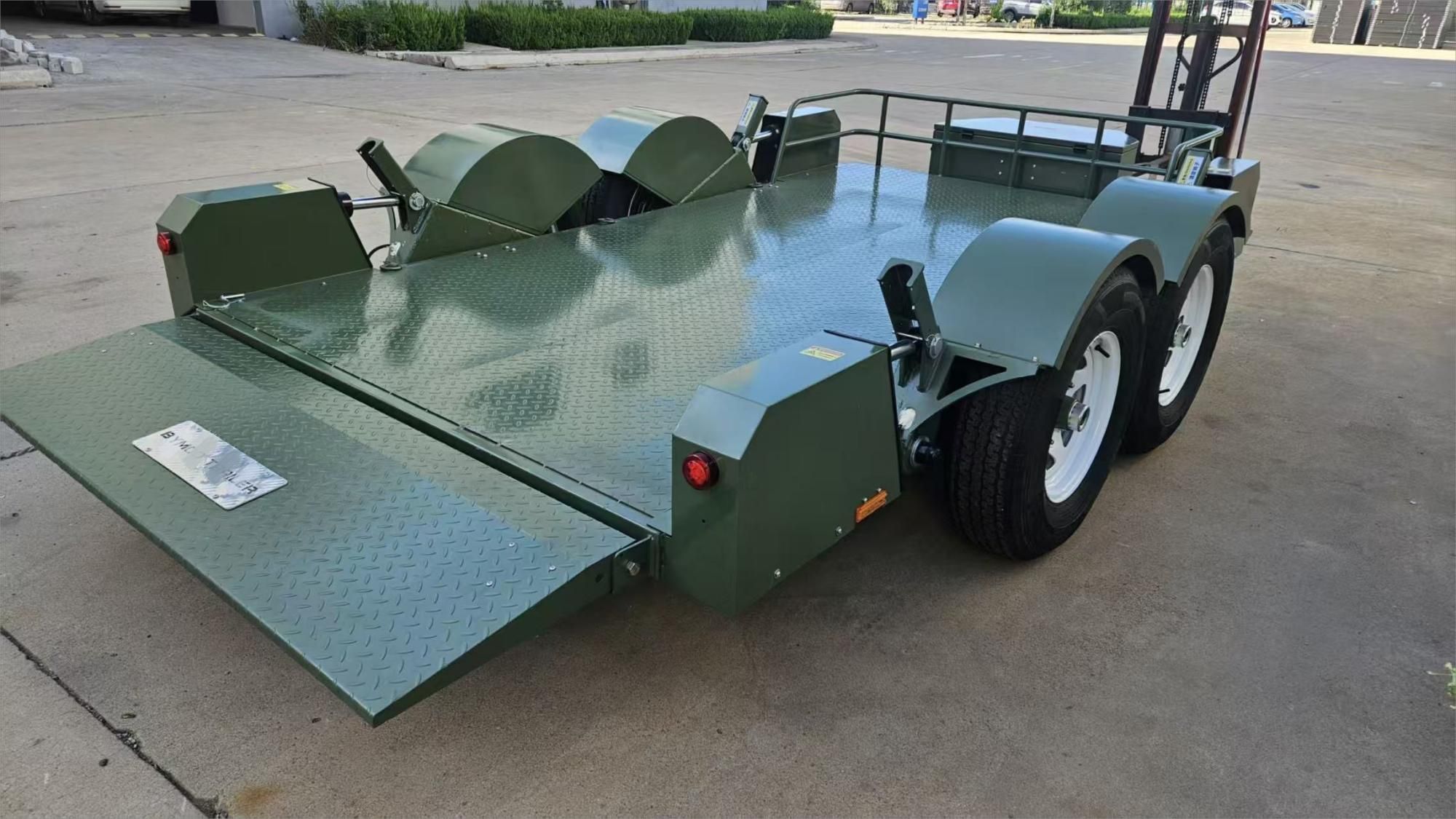
It offers a practical balance of payload capacity and maneuverability. The dual axles improve load distribution and stability on uneven terrain, while the hydraulic lift simplifies unloading of machinery, aggregates, or pallets. With a 5-ton rating, it can handle most skid steers, mini excavators, and material batches without requiring a heavy-duty truck to tow it, keeping operating costs manageable.
Ask for a factory visit, even a virtual tour, and look for in-house welding bays, paint shops, and assembly lines. Request videos of their CNC cutting and hydraulic cylinder testing. A genuine manufacturer will have engineering staff who can discuss design modifications, not just sales reps reading from a catalog. Check if they own the designs or hold utility model patents for specific chassis reinforcements or lifting mechanisms.
Look at the cylinder brand—preferably domestic brands like Yancheng Dongyang or well-known international seals. The rod should be chrome-plated with a smooth finish, with no visible porosity. Proper welding around the cylinder mounts and scissor arms should be full-penetration, not surface beads. Ask about the specified pressure rating and whether they perform burst tests on each batch. Thicker oil lines and a well-protected power unit (usually IP54 or higher) also indicate longer service life.
Axles directly affect load rating, braking safety, and trailer sway. For a 5-ton dual-axle, you want axles rated slightly above the gross trailer weight—say, 3-ton per axle capacity, leaving margin for dynamic loads. Spring suspension with heavy-duty leaf packs (like 8 or 10 leaves) handles rough Chinese construction sites better than torsion axles, which can overheat under constant undulation. The coupler matters, but a failed axle or broken spring causes loss of control; a coupler usually gives warning before failure.
Request a live load test video, not just a static photo. The trailer should be loaded to 125% of its rated capacity (6.25 tons) and driven over a mixed surface—concrete, gravel, potholes—while the lift is cycled several times. Check if the deck remains square and the lift doesn’t creep down. Also, ask for thickness measurements of the main frame rails and crossmembers. Some suppliers use 4mm steel where 6mm is needed to save cost, which leads to cracking at weld points. Insist on third-party inspection like SGS or Bureau Veritas if you cannot visit.
Many buyers focus only on FOB price but forget that trailers are often classified under HS codes that may attract anti-dumping duties or higher tariffs, especially in markets like the US or EU. Ask the supplier for the exact HS code and check with your customs broker. For payment, avoid 100% upfront; a Letter of Credit at sight or a 30/70 T/T split (30% deposit, 70% after inspection) gives leverage. Also, ensure the supplier handles proper lashing and corrosion protection for sea freight—trailers often arrive with rust if packed with bare metal exposed.
Customizations are common but they must be done by a supplier with real engineering capability. You can specify deck length, sidewall height, ramp style (spring-assisted or hydraulic fold-over), and even the type of lift (scissor or direct cylinder push). The biggest constraint is usually the supplier’s axle and cylinder inventory. Confirm that the changes won’t void the manufacturer’s structural engineering report or type approval, if required for road registration in your country.
Extremely important—hydraulic components will need seals and hoses over time. A good supplier stocks common wear parts and can ship them via air freight within days. They should supply a detailed parts book with part numbers, not just a generic manual. Ask for warranty terms in writing: typically 12 months for structural and 6 months for hydraulics. Also, check whether they have a local dealer or agent in your region who can handle warranty claims to avoid shipping the trailer back to China.
Conclusion
Finding a dependable source for a 5-ton dual-axle hydraulic lifting trailer goes far beyond skimming a glossy catalog. The real difference sits in the details of how these units come together—places like clustering of specialist workshops in Shandong or Hebei, where decades of hands-on welding and hydraulic fine-tuning create trailers that don't just pass a spec sheet but hold up under daily abuse. Instead of drowning in paperwork, ask to see live video walkthroughs of the factory floor, focusing on how they treat axle alignment jigs and cylinder testing rigs; a supplier who proudly shows you their messy, working test bay often cares more than one with a polished but empty showroom. Certifications matter, but not as mere badges—dig into whether their ISO or CE audits actually translate into consistent material traceability, like being able to pull a steel batch report for the chassis you're buying. The best shops will listen when you mention uneven terrain or frequent stop-starts, then suggest tweaks like reinforced pivot pins or a relocated control valve, proving their engineering isn't just copy-paste.
Pay attention to what happens after the invoice clears. A supplier worth sticking with offers more than a warranty card—they keep component diagrams and troubleshooting videos on hand, and they respond to a midnight WeChat message within minutes, not days. Reach out to real users, not just curated references: join overseas buyer groups or forums where dealers vent about cracked hose clamps or praise hydraulic pumps that still lift perfectly after two mango seasons. Those unfiltered stories reveal whether the after-sales support is a genuine safety net or a polite ghost. Before committing, trust your gut on red flags: a company that dodges questions about shipping crating, stumbles to explain hydraulic circuit logic, or refuses to provide a live video tour of their testing pit is likely trouble. Ordering heavy equipment remotely always carries risk, but when you pair technical curiosity with no-nonsense communication, the right partner emerges—one that treats your purchase not as a one-off deal, but as the start of a working relationship that lasts through breakdowns, upgrades, and repeat orders.
Contact Us
Contact Person: Ethan
Email: [email protected]
Tel/WhatsApp: +86 13963964935
Website: https://www.wholechaintech.com/