
Agricultural Drone Training Simulator: Top Picks and Recommendations
2026-08-30
Agricultural drone pilots know that real-world mistakes can cost time, crops, and equipment. That’s why simulator training has become a non-negotiable first step before ever lifting off a field. But with so many options flooding the market, how do you separate genuine training value from gimmicks? We tested the top agricultural drone simulators on realism, mission variety, and hardware compatibility. Among our picks, SRIZFLY stands out for its precise spray dynamics and crop-specific scenarios — yet the full list offers something for every skill level. Ready to train smarter, not harder?
Why Simulators Beat Real-World Practice for New Drone Pilots
Crashes are expensive, and for someone just learning to keep a quad in the air, real-world practice can burn through both money and confidence. A simulator removes that sting entirely. You can slam into a tree, clip a fence, or completely lose orientation at full speed, then hit reset and try again seconds later. No broken propellers, no bent motor shafts, no waiting for replacement parts. That instant recovery loop is something a physical field simply cannot offer.
Weather and location often dictate when a new pilot can fly outside, but a simulator is always ready. Windless afternoons, gusty crosswinds, even the cramped space of a backyard can be recreated on screen without leaving your desk. This consistency lets beginners drill the same maneuver dozens of times in one sitting, building the stick control and spatial awareness that usually take weeks of weekend flying to develop.
More importantly, simulators give you permission to fail in ways that would be reckless with a real drone. You can deliberately push past your comfort zone, fly aggressively through tight gaps, or test how the aircraft behaves when a motor loses power. Real-world training often encourages caution to protect the gear, but that caution slows progress. In a simulator, the fear disappears, and what remains is pure, focused practice.
What Separates a Useful Ag Drone Simulator from a Gimmick
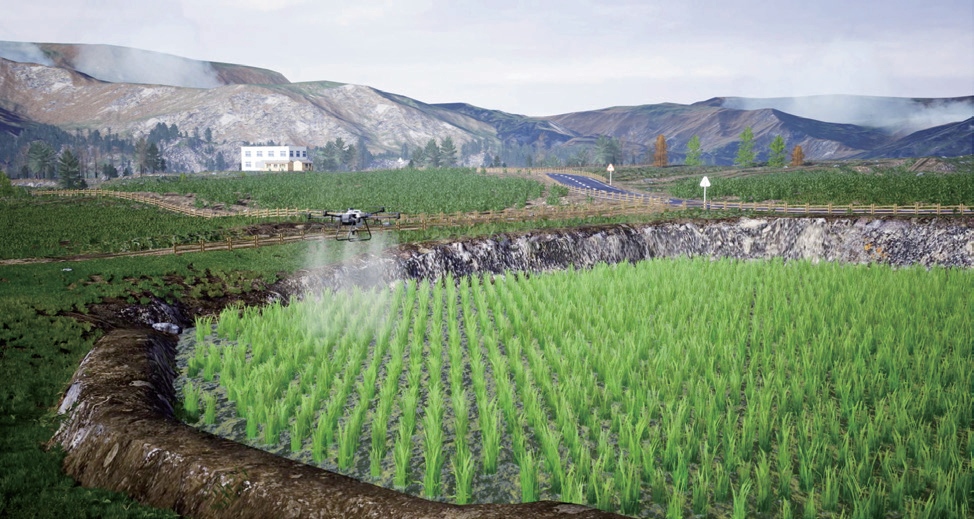
A simulator earns its keep the moment it stops mimicking flight physics and starts mirroring the messy, unpredictable conditions of a real field. Many products on the market feel like polished video games—smooth controls, perfect lighting, and crops that behave exactly as expected. But ask any operator who has flown over a soybean field with a crosswind pushing against the spray boom, and they’ll tell you that’s not where mistakes happen. The useful tool is the one that throws in wet leaves, sudden battery sag, or a GPS hiccup at the worst possible moment, forcing you to react the way you would with a $15,000 rig hovering over someone’s livelihood.
The second tell is whether the simulator ties back to real workflow, not just the joystick. A gimmick lets you do barrel rolls over a digital corn maze and calls it training. A genuinely useful simulator walks you through pre-flight checks, tank mixing, swath overlap planning, and post-flight data review. It doesn’t just track whether you stayed in the air; it grades you on spray coverage uniformity, missed headlands, and whether you would have caused off-target drift in a neighboring vineyard. If the software can’t export a log that helps you justify a nozzle change, it’s entertainment, not a tool.
Finally, look at how the simulator treats failure. Gimmicks punish you with a red “Game Over” and an instant respawn, which teaches exactly nothing. A useful simulator makes the crash expensive in time and consequence—you have to walk back to the truck, reset the boom, deal with a simulated chemical spill, and explain the delay to a virtual farm manager. That kind of friction feels tedious in a demo, but it’s precisely what builds the muscle memory for not cutting corners when the real tank is full and the wind is rising. If you leave a session without ever once muttering “that would have cost me a client,” chances are you just played with a toy.
Features That Matter When You Are Not in the Field
When work pulls you away from the site, the ability to check live readings from your phone becomes more than a convenience—it's what lets you relax. A good tool shouldn't force you to wait until you're back to discover something went wrong. Instead, it should hand you the key numbers the moment you open the app, whether that's fuel level, temperature, or signal strength.
Alerts that push themselves to you beat any manual refresh loop. The field doesn't pause just because you're not standing in it, so a system that flags unusual temperatures, low battery, or a dropped connection on its own saves you from playing detective later. You want the device to tap you on the shoulder before a small hiccup becomes a costly repair.
Unattended gear has to fend for itself, which is why build quality and battery life stop being spec-sheet bullet points and start mattering in real ways. A case that shrugs off dust and rain, a seal that keeps moisture out, and a battery that lasts through the whole cycle without a midday charge—these are the details that keep things running smoothly when nobody's around to babysit.
Our Favorite Training Platforms for Sprayer Drones
When it comes to getting comfortable with sprayer drones, the platforms that actually stick with us are the ones that avoid drowning you in slides. AeroSchool keeps its modules under ten minutes and pairs each one with a simulator session that mirrors the sluggish feel of a loaded tank. SprayWise Academy goes a different route: their crop-specific tracks force you to plan a spray mission for uneven terrain before you even touch the controller. The result is that you spend less time memorizing button layouts and more time thinking about drift, overlap, and battery swaps in the middle of a field.
We also keep coming back to DroneFarm Ready because it treats calibration as a recurring habit rather than a one-time checkbox. Their pressure and flow-rate drills use real telemetry from past jobs, so you learn to spot a clogging nozzle by the subtle drop in spray width. None of these platforms feel like a generic drone course with an agriculture skin slapped on. Instead, they lean into the messy parts: wind gusts near tree lines, tank refill timing, and the awkward choreography of landing on uneven ground.
Practicing Crop Scenarios Without Leaving Your Desk
You can test how a late frost in early May might affect your wheat stand, or check whether switching to a shorter-season corn hybrid would beat the first fall freeze. Instead of waiting a full year for field results, you run these as quick what-if trials on your computer, adjusting planting dates, soil moisture, and nitrogen rates with a few clicks.
The best part is that mistakes don’t cost you a single bag of seed. You can push a scenario too far—say, cutting back irrigation on sandy ground just to see what happens—and learn from the failure without risking a real field. Over time, these desk-bound experiments sharpen your instincts for the actual growing season.
Avoiding the Most Common Simulator Training Mistakes
A lot of simulator training goes sideways because people treat the debrief as an afterthought. Instead of rushing to the next scenario, spend at least as long unpacking what just happened. Ask the trainee to name one thing that felt harder than expected and one decision they would change. That simple habit catches bad patterns before they harden.
Another common slip is letting the technology drive the lesson. The software can track every metric, but that doesn't mean you should throw all of it at the learner at once. Pick two or three signals that actually matter for the skill you're building, and ignore the rest until those are solid. Overloading the screen with data tends to produce someone who watches gauges instead of the road or the patient or the panel in front of them.
Finally, don't let repeated runs become a comfort zone. If every session looks the same, the trainee gets good at that exact scenario and nothing else. Vary the starting conditions, add a minor malfunction, or change the weather. Small disruptions force real adaptation, which is the whole point of using a simulator instead of a textbook.
FAQ
Focus on realistic physics for spray drift and payload weight shifts, compatibility with common controller layouts, and whether it includes crop-specific scenarios like uneven terrain or obstacle-heavy orchards. A good sim lets you repeat a failed pass without resetting the entire field.
For overall realism, many pilots point to AGRAS Flight Simulator from DJI because it mirrors the actual stick response of their spraying drones and includes variable flow-rate feedback. SimFlightPro also gets mentioned for its custom field mapping, though its graphics feel dated.
Yes. DroneSim Pro has a limited free demo that covers basic forward flight and turns, but it lacks chemical load simulation. If you are on a tight budget, Velocidrone's agricultural expansion pack is cheaper than buying a dedicated ag sim and still gives you wind and weight adjustments.
Very important if you plan to transition to a specific drone brand. Using your actual transmitter with the simulator builds muscle memory for arming, mode switches, and emergency stops. Some sims, like RealFlight Evolution with the ag pack, support Spektrum and FrSky radios out of the box, while DJI's sim works best with their own controllers.
Look for uneven terrain with elevation changes, crosswind gusts, low-altitude obstacle courses, and variable crop heights. The best sims also simulate battery sag under heavy payloads and changing center of gravity as the tank empties, which is what catches new pilots off guard in real life.
It will not replace studying regulations or maintenance, but it can build the stick time needed for practical flight assessments. Simulated emergency procedures, like a motor failure at low altitude or a sudden GPS loss, are especially useful for passing the flight review portion.
Buying the most expensive option before checking whether it supports their current radio and computer specs. A $300 sim with a $100 USB dongle is worthless if your laptop cannot hold 60 frames per second over dense virtual fields. Start with a demo or trial and fly the same field three times before committing.
Conclusion
New agricultural drone pilots often rush to fly a real sprayer, but that's the fastest way to drain a battery—or a budget. Simulators let you crash, reset, and repeat without risking a $15,000 rig or damaging crops. The best ones don't just look pretty; they punish sloppy altitude control, wind drift, and uneven overlap. If a simulator feels like an arcade game with a drone skin, skip it. Look for tools that simulate nozzle clogging, varying tank weights, and terrain that actually affects flight. A useful platform saves your settings, tracks your progress, and forces you to plan a route instead of wiggling the sticks until something works.
Our favorite setups combine hardware controllers with crop-specific scenarios—soybean rust, uneven canopy, headland turns—without leaving your desk. You should be able to load a real field boundary, set wind gusts, and practice refilling and battery swaps. The biggest mistake we see is treating a simulator as a video game: flying full throttle, ignoring pre-flight checks, or skipping the boring calibration drills. Another common trap is only practicing in perfect weather. Real ag flying is about managing fatigue, spray drift, and surprise obstacles. Train like you work: set alarm clocks for battery changes, practice emergency landings in tall grass, and log every session. If a platform offers replays and performance metrics, use them—they'll expose bad habits faster than any instructor. In short, a good ag drone simulator is not a toy; it's a cheap flight school, a weather lab, and an agronomy tutor rolled into one. Pick one that respects the physics, not just the graphics.
Contact Us
Contact Person: Niles Liu
Email: [email protected]
Tel/WhatsApp: 8619945009803
Website: https://srizfly.com/