APAM Anionic Polyacrylamide Original Manufacturer Insights for Reliable Water Treatment
2026-09-16
Choosing the right anionic polyacrylamide (APAM) for water treatment often feels like a gamble—until you hear from the people who actually make it. As an original manufacturer, EVO has watched countless plants struggle with the same avoidable issues: unstable viscosity, poor floc formation, and overdosing that wrecks budgets. This post shares the manufacturing-level insights that separate reliable APAM from the rest, so you can stop guessing and start treating water with confidence.
What Actually Happens Inside an APAM Reactor?
Inside the reactor, the first thing that stands out is how carefully the monomers and water are blended before the initiator ever touches the mix. Acrylamide and the anionic co-monomer are stirred under a nitrogen blanket to strip dissolved oxygen, because oxygen is a notorious chain-transfer agent that would otherwise cap the growing polymer chains almost immediately. Once the oxygen level drops low enough, the redox initiator pair is injected, and the temperature begins to climb. That heat isn't a side effect; it's the signal that the free-radical polymerization has kicked off. Operators watch the temperature curve closely because the reaction front moves through the viscous mass in a way that's closer to a slow gelation than a simple liquid mixing.
As the viscosity builds, the reactor's agitator has to work differently. Early on it can run at full speed, but once the polymer chains lengthen and entangle, the torque spikes and the mixing shifts to a folding motion rather than turbulent stirring. This is when the anionic charge density gets locked into the backbone. The temperature is held in a narrow band, usually between 60 and 80 degrees Celsius depending on the exact formulation, and the residence time is tuned so the conversion reaches the high nineties. At the end, what's left is a rubbery, water-swollen gel that gets extruded, dried, and ground into the final granular product. The whole process lives or dies on controlling the heat and the oxygen, not on any exotic chemistry.
Why Anionic Matters More Than You Think in Turbidity Removal
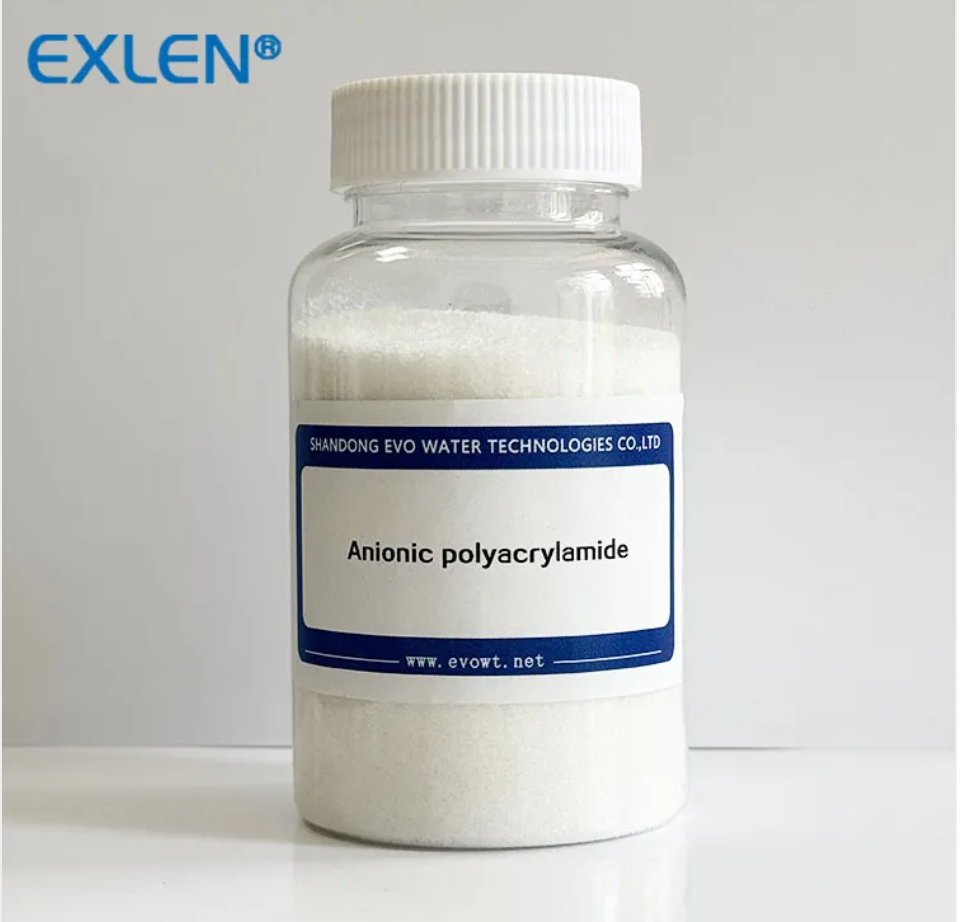
Most people assume any coagulant will knock down turbidity, but that assumption quietly breaks down when you look at what's actually suspended in the water. Anionic polymers don't just neutralize charge—they bridge fine particles into larger flocs that settle faster, even when the particles carry a net negative surface charge. This bridging action is often the missing piece in systems where inorganic salts alone leave a faint, stubborn haze.
The real difference shows up in low-turbidity, high-organic waters. There, a slight overdose of cationic chemistry can overshoot and restabilize particles, making clarity worse. Anionic polymers, by contrast, work through a gentler mechanism—adsorbing onto particle surfaces and linking them without aggressively reversing the zeta potential. That means a broader dosing window and fewer jar-test surprises on a Monday morning.
What's easy to overlook is the downstream benefit: better floc strength. Anionic-treated flocs tend to survive shear forces in rapid mixers and clarifier launders, reducing the need for re-treatment or filter aid. So if your turbidity readings plateau despite increasing coagulant dose, switching to or blending in an anionic polymer often unlocks the performance you thought was already maxed out.
Lot-to-Lot Consistency: The Quiet Metric Behind Dosing Confidence
When a clinician titrates a dose, they are trusting that the vial in their hand behaves like the one from the previous refill. Lot-to-lot consistency is what keeps that trust from becoming a guess. It doesn't show up in a single dramatic safety signal; it hides in small shifts—a slightly faster clearance in a handful of patients, a few unexpected mild infusion reactions, a titration that needs one extra step. Those faint drifts often trace back to changes in glycosylation, aggregate profile, or buffer composition that stayed inside release specifications but outside the narrow band of biological sameness. Dosing confidence grows out of that unglamorous reproducibility, not from any single batch's certificate of analysis.
The real challenge is that standard lot release tests can miss these drifts because they focus on chemical identity and broad potency ranges, not on how a patient's immune system or metabolic enzymes actually read the molecule. A product can pass every compendial test and still force a clinician to nudge the dose upward after a refill. Teams that track real-world outcomes across lots—time to reach therapeutic level, frequency of dose adjustments, rate of infusion reactions—begin to see a pattern that batch records alone don't reveal. That is when lot-to-lot consistency stops being a QC checkbox and becomes a clinical variable in its own right.
For narrow therapeutic index drugs and many biologics, even a 5% shift in exposure between lots can separate stable disease control from a flare or a relapse. Building dosing confidence means treating lot-to-lot consistency as part of the efficacy story, not as background manufacturing noise. It is the quiet metric because it rarely announces itself in a data cut, but its absence is felt in every unexpected dose change, every puzzled clinician, and every patient who wonders why the same prescription suddenly feels different.
Reading a Polymer Chain Like a Map: Molecular Weight Without the Hype
Think of a polymer chain as a winding trail on a map. Each repeat unit is a step along the path, and the molecular weight is simply how long that trail runs. But maps are rarely straight lines—some chains have side branches, loops, or curls that change how the material behaves far more than a single average number would suggest.
Most real polymers contain a mix of chain lengths, much like a landscape with hills and valleys. Short chains slide past each other easily, giving flexibility or easier flow, while long chains tangle and provide strength. Focusing only on an average molecular weight misses that terrain; the distribution of lengths is what actually dictates whether a plastic is brittle or tough.
Reading a polymer chain like a map means looking at the whole route, not just the distance between two points. You note where the path forks, how steep the climbs are, and where short cuts exist. Molecular weight data becomes useful when you treat it as a guide to the chain's real architecture—not as a magic number to impress with.
When Standard Grades Fail: Field Notes from High-Shear Applications
Out on the floor, the first sign is usually noise. A pump that ran quiet for months starts to rattle, or a mixer draws more amps than the motor plate promised. Pull the fluid apart under a microscope and the story is the same: long-chain polymers snapped into short fragments, viscosity craters, and whatever additive package was supposed to protect the metal simply isn't there anymore. Standard grades assume a gentle, steady shear. High-shear applications don't do gentle.
One coating line taught me this the hard way. We switched to a cheaper base stock to save a few cents a liter, and within a week the transfer rolls were streaking. The lab said the viscosity was in spec at 10 rpm, but at the application head—where shear rates hit six figures—the fluid had thinned to the point of dripping instead of metering. We ended up blending in a shear-stable thickener and bumping the molecular weight of the binder. Problem went away, but not before we scrapped four shifts of product.
The takeaway from the field is simple: don't let a spec sheet written for low-shear viscometry make your process decisions. Run a shear sweep, check for permanent viscosity loss, and if the curve falls off a cliff after a few minutes at high shear, you need a different grade. Sometimes that means a more expensive polymer. Sometimes it means changing the chemistry entirely. Either way, it's cheaper than shutting down a line at 2 a.m.
From Dry Powder to Fully Hydrated: The Overlooked 45 Minutes
Most people shake for ten seconds and drink. That leaves a gritty, clumpy mess that the stomach has to work overtime to break down. Letting the mixture sit for roughly 45 minutes changes everything: the powder absorbs liquid completely, the texture turns smooth, and the nutrients become far easier to digest.
It’s not just about texture. That quiet window allows the fibers and proteins to swell properly, which can prevent the bloating and heaviness that hit when you rush the process. If you’re using a shaker bottle, give it a second quick shake halfway through, then let it finish hydrating.
The difference is most noticeable with plant-based blends and casein-heavy formulas. Whey mixes faster, but even whey benefits from a longer rest. Set a timer, walk away, and come back to a drink that tastes closer to a proper shake than a hurried powder-and-water experiment.
FAQ
APAM's long-chain structure creates strong bridging flocs when it adsorbs onto suspended particles. In high-turbidity water, the anionic groups repel each other slightly, which keeps the polymer chains extended and better able to capture fine silt and clay. That extended conformation is what drives fast settling.
Charge density controls how strongly the polymer interacts with negatively charged particles. A moderate charge density, often around 20–30%, is frequently more useful than a very high one because it balances repulsion and adsorption. Too high a charge can reduce bridging efficiency, while too low fails to overcome particle stability.
Direct sourcing removes guesswork around product consistency. Original manufacturers can tailor molecular weight and charge density to a plant's specific raw water, provide batch-level quality data, and offer technical support without third-party markup. That support becomes important when seasonal water quality shifts demand dosage adjustments.
APAM works best with mineral-based slurries and inorganic sludge where particles carry a negative surface charge, while cationic types suit organic sludge rich in proteins or fats. Choosing the wrong charge can lead to weak flocs and higher polymer consumption, so jar testing with actual sludge is far more reliable than any general rule.
Start with jar tests using a 0.1% stock solution and dose in small increments, observing floc size and settling rate. Raw water turbidity, pH, and temperature all shift the optimum. Many operators find that running a quick dose-response curve during seasonal changes prevents overfeeding and saves polymer cost.
Higher molecular weight gives longer polymer chains, which can span more distance between particles and produce larger, faster-settling flocs. But extremely high molecular weight is not always better: it can create overly sticky flocs that clog filters or resist shear. Matching molecular weight to mixing energy is part of the art.
Yes, and the sequence matters. In most cases, adding the inorganic coagulant first neutralizes particle charge and forms microflocs, then APAM bridges those microflocs into larger aggregates. Reverse the order and the polymer may be consumed by the coagulant before it can perform its bridging role.
Keep the powder in a cool, dry place and keep bags sealed between uses. APAM absorbs moisture quickly, and even minor clumping reduces dissolution quality. For solution preparation, use clean water and avoid high-shear mixing, which can break polymer chains and lower effective molecular weight.
Conclusion
Inside an APAM production reactor, acrylamide and anionic comonomer units arrange themselves under controlled pH and temperature. What emerges is not just a long chain but a charge distribution that determines how the polymer interacts with suspended particles. In turbidity removal, the anionic character matters because most natural colloids carry a negative surface charge. A well-made anionic polyacrylamide bridges these particles through charge neutralization and polymer looping, forming flocs that settle quickly. Original manufacturers tune the reactor conditions to keep the anionic charge density steady, which directly affects how much polymer is needed on site.
Few plants pay attention to lot-to-lot consistency until dosing swings force them to. The quiet metric behind dosing confidence is whether every batch has the same molecular weight distribution and charge density. Reading a polymer chain like a map means looking beyond the marketed "high molecular weight" label and checking the actual viscosity and dissolution behavior. Standard grades often fail in high-shear applications where pumps or mixers tear the chain apart, so field notes point to using more robust grades with controlled branching. And while operators tend to add dry powder and expect immediate results, full hydration typically takes about 45 minutes under proper agitation. Skipping this window results in wasted polymer and unstable flocs. Manufacturers who document these details give water treatment plants a real basis for reliable performance.
Contact Us
Contact Person: Fiona Su
Email: [email protected]
Tel/WhatsApp: 8619963724144
Website: https://www.evo-chemical.com/