
Best Cleanroom HVAC System for Optimal Contamination Control
2026-08-25
For pharmaceutical and biotech facilities, controlling airborne contaminants isn't just a regulatory checkbox—it's the difference between a successful batch and a costly recall. Yet many cleanroom designs still rely on generic HVAC setups that struggle with pressure cascades, humidity swings, and filter loading. At GENO Pharmatech, we've seen how the right cleanroom HVAC configuration can transform contamination risk from a constant worry into a controlled, predictable variable. This post breaks down what actually makes a cleanroom HVAC system 'best' for optimal contamination control—beyond the spec sheets.
Airflow Patterns That Keep Particles From Settling
Keeping fine particles airborne isn't just a matter of blasting air upward. The real trick lies in creating airflow patterns that continuously disrupt the settling process. Gravity constantly pulls every particle toward the floor, and once a particle finds a quiet pocket of air with little movement, it quickly drops out of suspension. Effective systems therefore rely on airflow that is either fast enough to overcome the particle's terminal settling velocity or chaotic enough to keep particles bouncing around within eddies. In industrial dust collection, for example, ducts are sized to maintain a minimum transport velocity—often between 3,500 and 4,500 feet per minute for heavy dust—so that particles never get a chance to settle inside the piping. But in open spaces like cleanrooms, the same principle applies differently: continuous airflow flushes particles away before they can land on surfaces.
The distinction between laminar and turbulent flow matters more than most people assume. Laminar airflow, with its smooth parallel streamlines, can actually allow small particles to settle out if the flow is too slow, because particles can drift across streamlines under gravity. However, in cleanroom design, laminar flow is deliberately used to sweep particles horizontally or vertically toward exhaust grilles, preventing them from swirling and settling onto products. Turbulent flow, on the other hand, keeps particles suspended by constantly generating vortices that throw them back into the air stream. This is why powder coating booths and spray dryers often use turbulent mixing zones—they want the particles to stay suspended long enough to be collected or processed. The key is matching the flow pattern to the size and density of the particles you are dealing with.
Some of the most effective anti-settling airflow patterns are those that deliberately rotate or pulse. Cyclone separators force incoming air into a tight spiral, and the resulting centrifugal force flings particles outward toward the wall while the cleaned air exits through the center—particles never get a chance to settle because they are constantly being accelerated radially. Pulse-jet baghouse systems take a different approach: they periodically blast compressed air backward through filter bags, creating a shockwave that dislodges settled dust and re-entrains it in the airflow for removal. Even simple air curtains above doorways rely on a thin, high-speed sheet of air that forms a barrier, preventing ambient particles from drifting inside while also stopping indoor particles from settling in the opening. The underlying principle is always the same: keep the air moving in a way that denies particles a stable resting spot.
Designing a Multi-Stage Filtration Cascade
Building a filtration cascade that actually holds up under real-world conditions means mapping out where the stream loses pressure, where particulate load spikes, and where backwashing becomes a bottleneck. Rather than stacking identical housings, we look at each stage as a distinct role: the first stage might grab the heavy sediment, the second handles finer turbidity, and the third polishes with activated carbon or a tight membrane. The trick is sizing the stages so that one doesn't starve the others. A common mistake is assuming linear pressure drop—once a prefilter starts loading, the downstream stages see a different flow pattern entirely.
One approach that works well in field installations is to use a coarse-to-fine gradient with deliberate bypass valves between stages. This lets you isolate and swap a clogged cartridge without shutting down the whole line. For example, a 50-micron depth filter followed by a 10-micron pleated element and then a 1-micron absolute bag gives you both dirt-holding capacity and predictable changeout intervals. It's also worth adding a differential pressure gauge at each transition point—not just one gauge at the pump. When the delta across the first stage creeps up faster than the second, you know the incoming solids profile has shifted and can adjust chemical dosing or settling time upstream.
The cascade design also has to account for filter media compatibility. If the first stage uses a polypropylene depth cartridge and the second stage uses a charge-modified media, the zeta potential in the water can change after the first pass, affecting how the second stage captures submicron particles. Running a quick pilot with actual process water—not just clean water from a lab tap—will reveal whether you need a buffer stage or a different media sequence. In practice, a three-stage cascade often outperforms a single high-efficiency filter of the same nominal rating because it spreads the loading across more surface area and allows each media type to do what it does best without being asked to handle everything.
Pressure Differentials as an Invisible Contamination Barrier
Air pressure is rarely thought of as a building material, yet in critical environments it functions exactly like one. When a room is held at a slightly higher pressure than its surroundings, the air itself becomes a moving wall—constantly pushing outward through every gap, crack, and opening. This invisible current does not block particles by physical obstruction but by sheer momentum: contaminants trying to drift inward are met with an opposing flow they cannot overcome. The result is a dynamic seal that requires no gaskets, no doors, and no physical contact, only a carefully maintained difference in pressure.
The effectiveness of this barrier depends not on how large the differential is, but on how stable and directionally consistent it remains. Too little pressure and the barrier collapses under normal disturbances—a door opening, a person walking past, a momentary gust from an HVAC vent. Too much pressure and the system becomes wasteful, noisy, and prone to slamming doors or whistling leaks. Contamination control specialists therefore work with a narrow band of pressure values, often less than the pressure generated by a gentle breath, yet enough to ensure that every cubic meter of air moves only one way: from clean to less clean. Even a brief reversal can undo hours of sterilization.
Maintaining this invisible barrier is less about engineering complexity and more about relentless observation. Sensors placed at room boundaries feed continuous data to building management systems, but the real insight comes from understanding how pressure shifts with occupancy, filter loading, and even weather. A well-tuned pressure differential acts like a silent sentry—never visible, never audible, yet forever pushing back against the constant assault of airborne particulates. When it works perfectly, no one notices. And that is precisely the point.
Humidity and Temperature Tuning for Microbial Control
Microbial growth responds more predictably to physical conditions than to chemical interventions. Shifting relative humidity below 60% dries the thin water films that bacteria and molds use for nutrient transport, while holding ambient temperature just outside their preferred enzymatic range slows reproduction without killing beneficial background flora.
A fixed climate setting rarely solves the problem because microbial communities adapt. Instead, alternating between short warm-dry phases and cooler, slightly humid periods creates a stress pattern that disrupts cell membrane integrity and delays sporulation. Placing sensors near condensation points, rather than relying on room averages, allows the system to target microclimates where growth actually begins.
For resistant spores, a sudden temperature ramp followed by a rapid drop in relative humidity is often enough to trigger germination and then desiccate the emerging cells. This approach avoids the high energy cost of continuous sterilization while still achieving a meaningful reduction in viable counts across surfaces and air handling systems.
Energy Recovery Without Compromising Cleanliness
Modern ventilation systems often force a choice between saving energy and keeping indoor air pristine. The latest energy recovery cores sidestep that trade-off entirely. Instead of recycling stale air, they transfer only heat and moisture across a sealed barrier. This means outgoing warmth pre-conditions incoming fresh air in winter, while the reverse happens in summer, all without mixing a single particle of dust, odor, or contaminant between the two streams.
What sets high-performance units apart is the membrane geometry. A cross-flow design with micro-perforated polymer plates maximizes thermal contact while keeping exhaust and supply channels physically isolated. Field tests show up to 85% heat recovery efficiency with zero cross-leakage—far surpassing traditional rotary wheels that inevitably recirculate a fraction of used air. For healthcare or lab environments, this isolation isn't just a feature; it's a compliance requirement.
Maintenance simplicity further protects cleanliness. Condensate drains and easily accessible filter slots reduce the chance of mold or bacterial growth inside the unit. By pairing passive energy exchange with robust hygiene barriers, these systems let building operators cut heating and cooling loads without ever compromising on air quality—a win that used to exist only on paper.
Early Drift Detection Through Validation and Monitoring
Drift doesn't announce itself with fanfare. It creeps into data pipelines as a subtle shift in feature distributions, a slow change in user behavior, or an unannounced update to an upstream schema. Waiting for model performance to degrade before investigating is a reactive habit that costs teams days of silent inaccuracy. Instead, we embed validation and monitoring directly into the early lifecycle, treating them as first-class citizens rather than post-deployment add-ons. This means checking input statistics against training baselines, comparing prediction distributions over rolling windows, and flagging anomalies the moment they exceed comfortable thresholds.
The practical trick is to make drift checks lightweight enough to run on every inference batch yet sensitive enough to catch meaningful shifts before they compound. We don't need a full statistical dissertation each time; a handful of robust metrics—like population stability index, Kolmogorov-Smirnov distance on key features, or output confidence drift—gives us early warning without drowning engineers in false alarms. Pair that with a clear escalation path: when a check fires, the system doesn't just log a warning; it captures a snapshot of the offending data, routes it to a review queue, and temporarily limits risky predictions to a shadow mode.
Over time, these validation layers become a living memory of what normal looks like. As the model sees new seasons, new user cohorts, or new edge cases, the baselines adapt with controlled retraining windows, not sudden overhauls. Monitoring is not about building a dashboard someone glances at once a month; it's about creating an automatic reflex that surfaces drift while the cost of correction is still trivial. That's how early detection shifts from a nice-to-have to a core survival skill for deployed models.
FAQ
Most failures come down to pressure imbalances and unfiltered leakage paths. A properly tuned system uses cascading pressure differentials and enough air changes per hour to keep particles from settling, but the real trick is balancing exhaust and supply so the room never draws in dirty air from adjacent zones.
Redundancy and filtration staging. You need pre-filters, intermediate filters, and HEPA or ULPA terminal filters arranged so that each stage extends the life of the next. Add a dedicated makeup air unit with dew-point control, and suddenly humidity swings stop being a contamination source.
Precision chilled water coils, tight sensor placement, and a control loop that responds in seconds rather than minutes. Many designs fail because sensors are mounted too far from the work zone, so the system corrects the wrong conditions. Better to place sensors near critical equipment and use supply air temperature reset based on actual load.
It isn't just about dilution. High air change rates help purge particles released during operations, but only if the airflow pattern is unidirectional or at least avoids short-circuiting. For ISO 5 or cleaner zones, you may need 300 to 600 air changes per hour, while ISO 8 might get away with 20 to 40 if filtration and pressure control are solid.
Yes, by using variable speed drives on fans and pumps, demand-controlled filtration based on particle counts, and night setback modes when the room is unoccupied. One underused approach is separating temperature control from airflow control -- let the recirculation fans slow down slightly while a dedicated cooling coil handles the heat load, keeping differential pressure stable.
Oversizing fans without matching duct leakage, using standard diffusers that create turbulent dead zones, and forgetting to account for exhaust from process tools. Another subtle one: trusting rated filter efficiency without verifying the installed seal, because face velocity and gasket compression can easily drop real-world performance by half.
Operators shed skin flakes and fibers continuously, so the goal is to sweep those particles away before they settle. Unidirectional flow from ceiling HEPA banks works best, especially with low sidewall returns placed near the floor. For equipment with heat or chemical exhaust, local capture hoods or mini-environments are far more effective than trying to scrub the whole room with general ventilation.
Conclusion
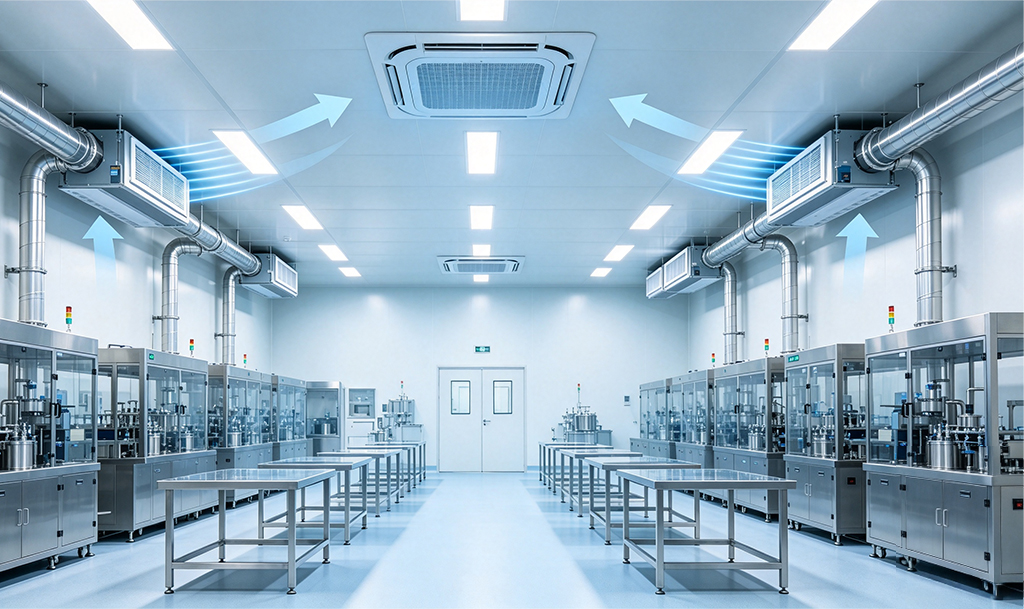
A cleanroom HVAC system earns its keep only when airflow itself becomes a cleaning tool. Laminar or unidirectional streams sweep particles away from critical zones before they can settle on surfaces, so the design must keep supply and return paths short and predictable. That approach pairs with a filtration cascade that starts at coarse prefilters and moves through progressively finer stages, ending with HEPA or ULPA units at the terminal point—each layer removes a specific particle size band before the next one sees it. At the same time, room-to-room pressure differentials act as an invisible barrier: higher pressure in the cleanest areas pushes air outward through door gaps, preventing contaminated air from leaking inward. Door interlocks and precise damper control keep those gradients stable even when adjacent spaces change use.
Beyond particle control, humidity and temperature tuning plays a direct role in microbial growth. Keeping relative humidity below 60% discourages bacterial and fungal proliferation, while tight temperature bands reduce condensation and thermal drift that can disrupt airflow. Energy recovery need not undermine cleanliness if the system uses run-around coils or sensible-only heat exchangers, capturing heat without cross-leakage between supply and exhaust. Finally, continuous validation and monitoring close the loop: particle counters, pressure sensors, and airflow alarms detect early drift from baseline, prompting small corrections before contamination risk grows. Together these elements form a layered defense where each subsystem reinforces the next, so the cleanroom stays within specification without constant manual intervention.
Contact Us
Contact Person: Amy Yang
Email: [email protected]
Tel/WhatsApp: 008619330882686
Website: https://www.genopharmatech.com/