Boron Carbide Tiles Company What Buyers Need to Know
2026-10-21
Most boron carbide tile buyers start with hardness data and end up surprised by hidden variables—bonding, edge retention, and real-world wear patterns that spec sheets never mention. If you're planning a bulk order, the wrong assumptions can cost you more than just money. Here's what actually matters when evaluating suppliers, straight from the team at HUAYI TECH.
How Boron Carbide Stacks Up Against Standard Wear Tiles
Standard wear tiles, typically made from alumina or silicon carbide, hold up reasonably well in many industrial settings. But when the abrasion gets severe, boron carbide reveals a clear edge. Its hardness lands around 9.5 on the Mohs scale—only diamond and cubic boron nitride sit above it. In practice, that translates to a service life three to five times longer than alumina tiles under identical sliding abrasion. Facilities that process sand, coal, or ceramic powders often see the difference within weeks, not years.
Weight also plays a bigger role than most people expect. Boron carbide has a lower density than alumina or silicon carbide, so a liner made from it can cut the total mass of a chute or hopper by a third or more. That reduces stress on support structures and makes handling sections easier to install. The upfront cost is higher—no question—but fewer shutdowns for tile replacement and less downtime quickly shift the math in its favor. Add in better resistance to thermal shock and many acids, and the comparison stops being close for anything beyond light-duty wear.
The Real Cost Drivers Behind Boron Carbide Tile Quotes
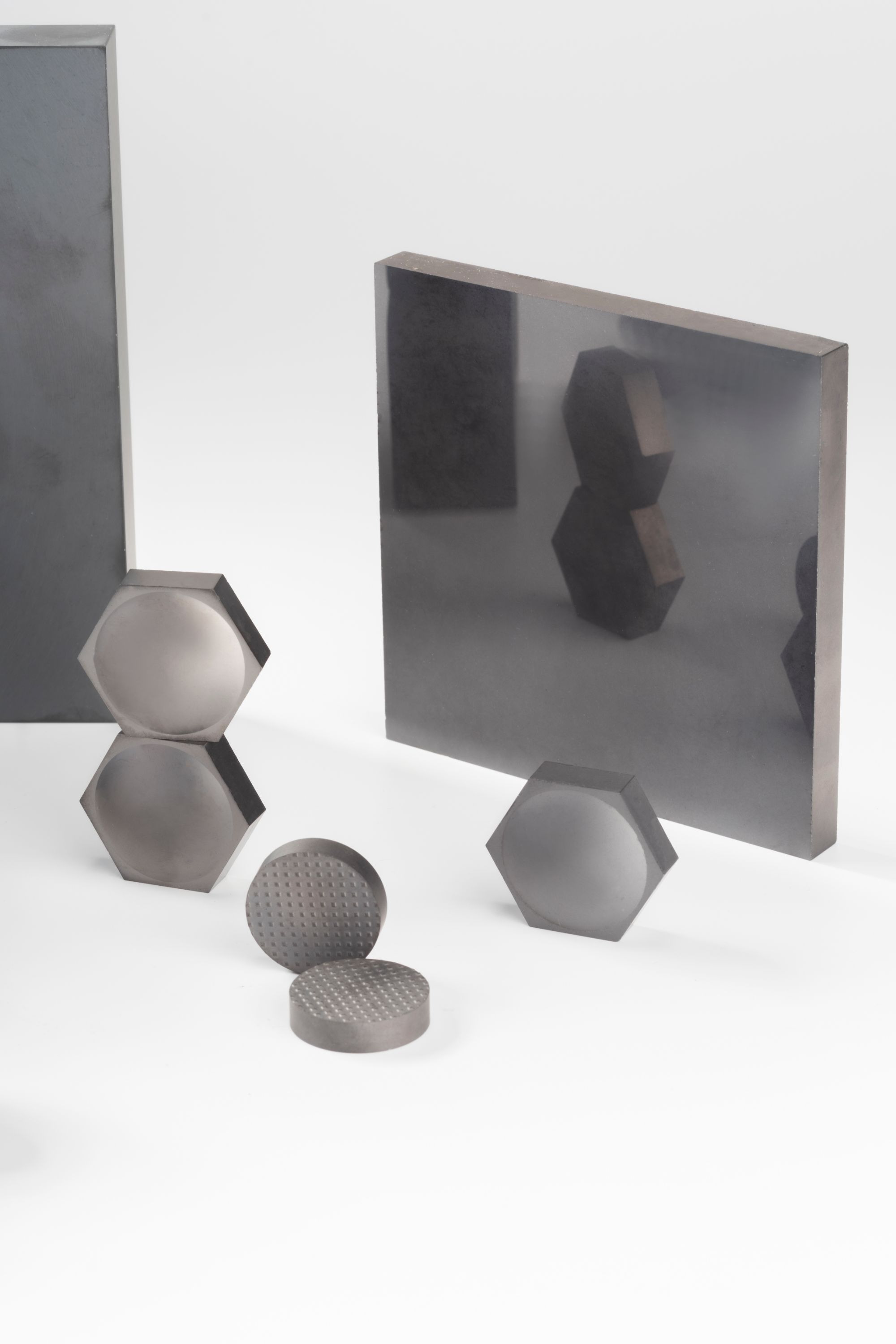
Most people assume tile dimensions set the price, but the real starting point is the boron carbide powder itself. Higher purity grades with a narrow particle size distribution cost significantly more because the milling and classification steps produce a lot of reject material. Suppliers often bury this as a “raw material adjustment” line item rather than baking it into the tile cost, so two quotes for the same size can look identical until you read past the base number.
The consolidation method is another major driver that rarely gets discussed openly. Hot pressing delivers near-full density and excellent hardness, but it limits batch size and wears out graphite molds quickly. Pressureless sintering can produce larger tiles at lower tooling cost, yet it typically requires sintering aids that slightly compromise ballistic performance, and a post-sinter hot isostatic pressing step adds back expense. The quote should reflect which route the supplier actually uses, not just a generic “sintered” description.
Finishing and proof testing are where margins hide. Grinding boron carbide is slow and chews through diamond tooling, so tight flatness specs or chamfered edges can add more to the final price than the raw tile blank. Then there’s ballistic testing: some shops include a batch test certificate, while others treat V50 or multi-hit verification as a separate line item you only see after you ask. If a quote feels suspiciously low, check whether the testing load is realistic or quietly deferred until after purchase.
What Actually Happens When a Tile Takes a Direct Impact
Most people see tile as a monolithic slab, but impact stress doesn't spread uniformly. At the exact strike point, the glaze compresses and the underlying bisque takes the brunt in a cone-shaped zone. If the tile's internal tension limit is exceeded within microseconds, hairline fractures form where the glaze meets the body, creating that telltale spider-web pattern.
What gets missed is the delayed damage. The initial chip may look shallow, yet the shockwave keeps moving outward and downward, reaching the thin-set layer. There, it can break the bond between tile and substrate, leaving a hollow pocket that echoes underfoot. Over weeks, normal thermal cycling and foot loads pump those cracks open, letting in moisture that accelerates spalling from the edges inward.
The failure often isn't from the single blow itself but from the repeated micro-movements afterward. A tile that survives a dropped tool can still loosen months later because the impact robbed the adhesive of its grip along a small but critical area, and that weak spot becomes a hinge point for further cracking.
Which Industries Get the Most from Boron Carbide Linings
Mining and mineral processing operations see dramatic wear reduction when boron carbide linings are installed in chutes, hoppers, and slurry transfer lines. The material's hardness—second only to diamond—allows it to shrug off the constant scouring from crushed ore, silica sand, and tailings that quickly destroys rubber or hardened steel. Maintenance crews often extend replacement intervals by a factor of three or more, which translates directly into fewer unplanned shutdowns.
Coal-fired power plants rely on boron carbide linings in pulverizer discharge pipes, ash handling elbows, and classifier cones. Those components face a relentless stream of high-velocity coal dust and abrasive fly ash. By lining only the most impact-prone zones rather than entire systems, plant engineers keep costs manageable while protecting critical bends and tees from premature failure.
Abrasive blasting and waterjet cutting shops also get exceptional value from boron carbide. Blast nozzles, mixing tubes, and orifice inserts made from this ceramic outlast tungsten carbide alternatives several times over, even when running garnet, aluminum oxide, or crushed glass at high pressure. The reduced replacement frequency means operators spend less time swapping worn parts and more time on actual surface preparation.
Signs You're Talking to a Supplier Who Actually Makes the Tile
A real tile maker rarely answers a customization question with “we can probably do that.” Instead, you'll hear about the bisque firing temperature, the glaze cone rating, or whether the body can survive exterior freeze-thaw cycles. They ask about substrate movement, grout joint width, and expected loading before they confirm a price. That granular back-and-forth is the difference between someone who mixes clay and someone who just forwards an email.
Samples are another strong tell. A factory will send a tile pulled from the last production run, often with a handwritten batch number or a note about kiln variation. They might warn you that the third tile in the box will look slightly darker than the first because of where it sat in the kiln. A reseller with a brochure can't offer that kind of detail because they've never seen the line start up.
Lead times also separate manufacturers from middlemen. A real supplier quotes five to seven weeks because that's how long the clay needs to dry, fire, and cool properly. They'll explain that a textured glaze adds an extra day of production. If you hear “it ships tomorrow” for a tile that was just customized for your project, you're probably talking to someone who has never walked a production floor.
Installation Mistakes That Ruin Boron Carbide's Advantage
A lot of boron carbide failures get blamed on the material itself, but a closer look often points to installation. The ceramic is extraordinarily hard, yet it doesn't tolerate point loads well. When bolts are over-torqued or the backing plate isn't flat, you create tiny stress risers that turn into cracks long before any real impact happens. Those cracks stay invisible until the panel is asked to do its job.
Surface preparation is another silent killer. Boron carbide doesn't bond well to just any adhesive straight out of the box. Skipping the degreasing step or using an epoxy without a proper primer leaves a weak interface. Under ballistic load, that bond line fails first, and the ceramic tile separates from its backing, wasting all its protective potential.
Thermal expansion mismatches also cause trouble. If you rigidly fasten a boron carbide plate to a steel or aluminum frame with no allowance for movement, temperature swings will generate significant stress. People sometimes force the bolt holes to align during installation, which preloads the ceramic in exactly the wrong way. The result is a panel that's already fighting itself before it's ever struck.
FAQ
Boron carbide offers a lower density paired with extremely high hardness, so you get meaningful weight savings without sacrificing ballistic stopping power. That combination is hard to match in other ceramic armor materials.
Request batch-level test reports for density, hardness, flexural strength, and fracture toughness. If possible, ask for a small sample set and have it independently tested against the supplier's claimed values.
They are most commonly used in body armor, vehicle armor, helicopter seats, and other ballistic protection systems where reducing weight is critical. Some specialized nuclear shielding applications also use them.
Ask whether the supplier uses hot pressing or pressureless sintering, and at what temperature and pressure. Hot-pressed tiles typically achieve higher density and more consistent mechanical properties, but the process costs more.
Yes, but it depends on the manufacturer's tooling and pressing capabilities. Curved or complex geometries usually require dedicated molds, which can add lead time and cost. Always confirm tolerance limits before ordering.
Raw boron carbide powder purity and particle size are major factors, along with the sintering method and final dimensional tolerances. Tighter tolerances or higher purity grades can raise the price significantly.
Keep them dry and avoid impacts on edges or corners, which are more brittle than flat faces. Use padded packaging for transport and store tiles flat with separation layers to prevent chipping.
For standard flat tiles, expect anywhere from 4 to 10 weeks depending on the supplier's production queue and order size. Custom shapes or very large quantities can extend this to 12 weeks or more.
Conclusion
When evaluating boron carbide tiles for demanding wear applications, buyers quickly discover that not all ceramic linings are created equal. Boron carbide stands apart from standard alumina or even silicon carbide tiles due to its exceptional hardness, second only to diamond, and its light weight, which translates into lower energy consumption in rotating or sliding equipment. Yet the decision to specify boron carbide involves more than just comparing hardness ratings. Real cost drivers behind tile quotes include raw material purity, sintering method, tile thickness tolerance, and the complexity of shaping—factors that directly influence performance under direct impact. Unlike traditional wear tiles that may crack catastrophically, boron carbide tends to absorb high-velocity particle strikes through micro-fracturing at the impact point while preserving the underlying substrate, a behavior that extends service life in cyclones, chutes, and pneumatic conveying lines. Industries such as mining, defense, nuclear, and abrasive waterjet cutting consistently gain the most from these linings, where downtime costs dwarf the initial material premium.
A crucial but often overlooked aspect is supplier capability. Signs you are talking to a manufacturer rather than a reseller include the ability to provide custom shapes, in-house sintering data, and documented batch-to-batch hardness consistency. Even the best boron carbide tile will underperform if installed incorrectly. Frequent installation mistakes include using rigid epoxy on vibrating surfaces, failing to bevel tile edges at high-wear transition zones, or neglecting to stagger joints in high-velocity slurry lines. These errors create stress concentrations and chipping that erase the material's natural advantage. Ultimately, buyers who understand both the material science and the practical installation pitfalls are better positioned to secure linings that deliver years of reliable service without the hidden costs of premature failure.
Contact Us
Contact Person: Junting Leo
Email: [email protected]
Tel/WhatsApp: +86 18615009766
Website: https://www.huayimaterial-china.com/