
Carousel Rotomolding Machine Company: Reliable Rotational Molding Solutions for Complex Hollow Parts
2026-11-21
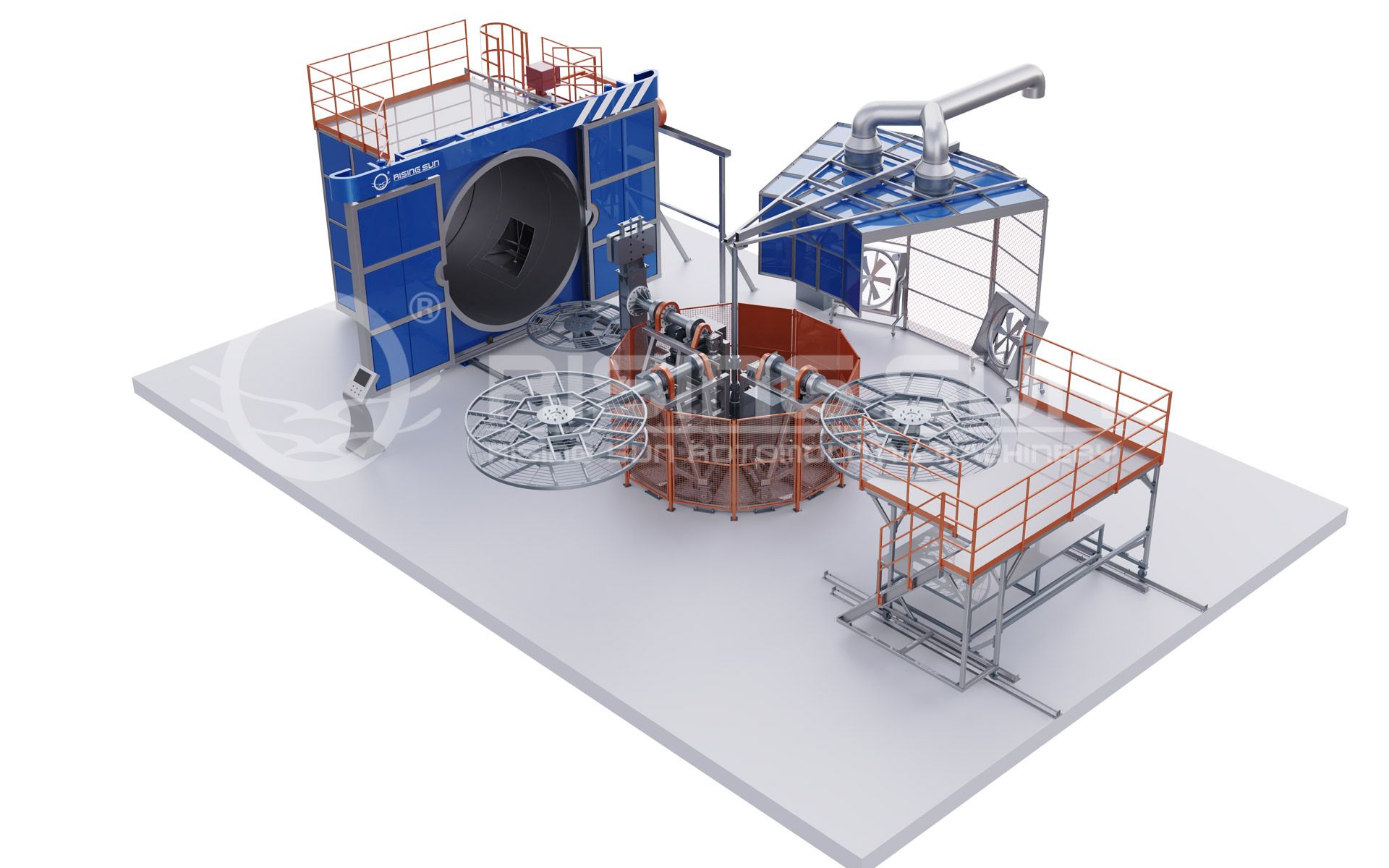
Complex hollow parts leave very little room for error—uneven walls, trapped threads, or a slight shift in cooling can turn a good design into scrap. A carousel rotomolding machine needs to manage those variables across every arm, every cycle. Rising Sun approaches this with machine designs that treat heat, rotation, and cycle timing as one connected system rather than isolated settings. That matters when the part geometry is anything but straightforward. In this post, we break down what reliable rotational molding looks like for demanding hollow components and where the right carousel platform removes the guesswork.
When Complex Hollow Parts Outgrow Standard Rotomolding
Standard rotomolding handles simple tanks and bins well, but complex hollow parts quickly move beyond its comfort zone. Deep undercuts, narrow channels, molded-in threads, metal inserts, and sudden wall thickness changes alter how powder flows and how heat reaches the cavity surface. A thick boss next to a thin rib may cure fully in one area while the other stays under-sintered or starts to degrade. The result is usually warpage, internal voids, or dimensional variation that standard cycle profiles cannot correct.
Tooling becomes another limit. Multi-piece molds, drop boxes, and moving cores add expense and maintenance, yet they still may not produce a complete fill in tight internal features. Some geometries simply cannot be reached or cooled evenly during biaxial rotation. Cycle times stretch, oven settings need constant adjustment, and scrap rates climb even with careful manual intervention. Chasing conventional parameters at this stage brings diminishing returns.
At that point, fabricators often turn to pressurized rotomolding, controlled internal air during cooling, or hybrid tooling with integrated cores and secondary operations. More important is a shift toward process modeling and thermal monitoring rather than trial and error. These approaches preserve the one-piece hollow structure while allowing tighter tolerances, better surface finish, and shapes that a standard machine and mold were never meant to handle.
Carousel Motion and the Repeatability of Wall Thickness
In continuous rotary blow moulding, the carousel does not simply index from one station to the next; it sets the timing for every step between parison drop and final ejection. Small differences in rotational speed, bearing clearance, or guide rail wear can alter how long the parison hangs before the mould closes. That extra fraction of a second of sag changes the wall distribution before blow air ever enters the cavity, and the result shows up as a light shoulder or a heavy base that drifts from one cycle to the next.
Repeatability also depends on how evenly the wheel holds temperature around its full rotation. A cavity near a warmer frame section or an open air current may run slightly hotter than the others, even when the heater settings look identical on screen. Operators sometimes respond by nudging individual die gaps to correct the wall profile, but those adjustments often mask a mechanical or thermal imbalance in the carousel itself. Once the underlying motion and heat transfer are steady, the same settings begin to produce the same wall thickness from cavity to cavity.
Worn cam followers, a sticking clamp, or a transfer arm that has shifted by a millimetre can all introduce phase errors that accumulate over a production run. These are not dramatic failures, so they rarely trigger alarms. Instead, they show up as wider variation in wall thickness measurements and occasional scrap parts that are difficult to trace. Checking the carousel for smooth dwell, consistent acceleration, and proper alignment often closes that gap faster than repeated recipe changes.
Powder Flow and Material Prep Before the Oven Ever Heats
The way powder moves through the feed system often decides coating uniformity long before the first heating zone reaches temperature. A batch that bridges in the hopper or packs unevenly in the transfer line will create surges and starved spots downstream, and no amount of oven tuning can fully correct that. Watching how the material settles, how it slides across a discharge chute, and whether it picks up static gives a much better read on the day’s run than simply trusting the virgin specification sheet.
Sifting out agglomerates and letting the powder rest in a dry, temperature-stable area are simple steps that pay off quickly. In humid conditions, moisture uptake can turn a free-flowing product into something that clumps against feed screws and spray nozzles. Some crews will pre-condition the powder near the line for several hours, while others rely on gentle fluidization to break up soft packing. The key is consistency: if the material arrives at the pickup point with roughly the same bulk density and moisture level every time, the downstream settings stay meaningful.
It also helps to track flow indicators batch by batch rather than reacting only when defects appear. A shift in angle of repose, a change in sieve residue, or a jump in static cling can warn of trouble before the oven sees a single part. Small adjustments in feed rate, air pressure, or hopper level can then be made early, when they still matter. Once the powder enters the heat, the window for correcting flow-related defects is mostly gone.
Tooling Decisions for Undercuts, Inserts, and Uneven Walls
Undercuts rarely get solved by a single component choice. A shallow snap feature on the inside of a boss may only need a lifter or an angled ejector pin, while a deep external groove that runs perpendicular to the parting line can force a hydraulically actuated slide, a collapsible core, or even a split cavity insert. The tooling call hinges on the demolding stroke, the plastic's stiffness at ejection temperature, and whether the undercut can be reached from the side without fighting the main core.
Inserts earn their place when the base steel would be difficult to machine, vent, cool, or maintain. I lean toward hardened inserts for thin, tall ribs or areas near the gate where abrasive fillers chew through unhardened pockets. The tradeoff is tolerance stack and alignment: each insert adds a witness line and another set of screws or keys to keep square. When the feature needs to be swapped after wear or fine-tuned for shrinkage, an insert usually beats cutting a whole new cavity block.
Uneven walls show up as warpage long before they show up as scrap. In the tool, that often means shifting the core to buy back some steel where the part was thickened, or adding local cooling circuits that pull heat out of a heavy boss before the adjacent rib freezes. Sometimes the better tooling decision is not to chase the wall mismatch with steel alone but to change gate placement or valve timing so the thick section packs under lower stress.
Cooling Rate, Cycle Time, and Keeping Warp in Check
Mold temperature and coolant flow often get treated as afterthoughts once the cycle stabilizes, but small shifts here show up quickly as dimensional drift. A faster cooling rate can shorten cycle time, yet it also freezes in higher internal stress near the gate and along thick-to-thin transitions. That stress may not appear at the press; it shows up later as warp after the part has had time to relax.
Balancing the cooling lines so the cavity and core remove heat at similar rates does more for flatness than simply cranking up chiller capacity. Where the geometry forces an uneven thermal load, splitting the circuit or adjusting flow to the hotter side can reduce the temperature delta that drives bowing. Cycle time gains from aggressive cooling are only real if the part can hold tolerance without a secondary straightening step.
Watch the ejection temperature. Demolding a part while the surface is still soft or while the core is hotter than the cavity tends to produce a consistent warp direction, so the problem becomes built into the process. A short hold under clamp pressure after cooling, or a slight reduction in coolant temperature on one side, often brings warp back into check without adding meaningful seconds to the cycle.
Inspection Methods for Hollow Parts That Hide Their Flaws
Hollow parts present a unique challenge in quality control: the defects that matter most are often buried where no direct line of sight exists. Surface checks catch only what is visible, while internal voids, inclusions, and wall-thickness variations remain hidden until a part fails in service. A reliable inspection strategy therefore has to move beyond simple visual or touch-based methods and account for the geometry that makes these components both useful and difficult to evaluate.
One practical approach is to combine multiple non-destructive techniques in a sequence that respects the part's shape. Ultrasonic testing works well for detecting deep-seated discontinuities in metal hollow sections, while radiographic imaging can reveal density changes and trapped material inside complex cavities. For thinner walls or near-surface flaws, eddy current or phased array methods often provide the missing sensitivity. The key is not to rely on a single method as a catch-all, but to map which technique answers which specific question about the hidden interior.
Calibration and reference standards also play an outsized role when flaws are concealed. Without a known defect of similar size and position inside a comparable hollow geometry, even a well-chosen inspection method can produce ambiguous results. Building a small set of controlled test pieces with artificial flaws placed at critical stress points gives inspectors a baseline for interpreting signals. This turns a hidden defect from a guess into a measurement, and that shift is what separates a pass/fail check from a genuinely informative evaluation.
FAQ
That depends on the arm length and swing diameter you choose. We have built stations for small medical housings under 10 liters and for tanks up to several thousand liters, so the machine envelope is usually tailored around your mold set rather than forcing parts into a fixed size class.
Yes. The multi-station design gives you enough cycle time to place inserts, vents, and drop boxes before the mold enters the oven. Foam-filled parts are also common because the rotation can be paused or slowed at specific points without affecting other stations.
We use programmable arm speed ratios, independent heating zones, and mold venting adjustments. During process development we map wall thickness on cut sections and adjust the heating profile and rotation pattern per station, which helps on parts with narrow cavities or sharp radii.
The ovens and controls are set up for the usual polyethylene and cross-linked polyethylene grades, plus polypropylene, nylon, PVC plastisol, and some filled or foamed systems. The temperature and residence time can be tuned for materials that need a tighter processing window.
They can. Each arm has its own temperature, time, and rotation settings, so you can run one cavity for a large tank and another for small covers at the same time. The main practical limit is matching overall cycle lengths so no station waits unnecessarily.
We review mold drawings for draft angles, parting lines, vent locations, and insert retention before the mold is built. For new designs we often help with prototype tooling and trial runs, then adjust the process parameters on the carousel until the part dimensions and surface finish are stable.
Most of our current builds use variable frequency drives, modulated burners, and insulated oven chambers, which reduces idle fuel consumption. The ability to run different stations independently also means you are not heating and cooling the whole machine just to produce one small part.
We keep common spare parts in stock, offer remote troubleshooting, and can send a technician when needed. We also train your operators and maintenance crew on the specific carousel configuration, including arm timing, burner settings, and safety interlocks.
Conclusion
When a hollow part moves past the size or geometry limits of a standard machine, the usual workarounds start to show stress: uneven walls, trapped powder, or long cycle times that drift with every shift. Carousel Rotomolding Machine Company approaches these jobs from the motion side as much as the heating side. A rotating multi-station carousel keeps the mold moving through heat and cooling zones at a controlled pace, which matters more than it sounds. It allows each swing and dwell to be repeated without the operator constantly chasing settings. Before the oven ever runs hot, attention goes to powder flow, bulk density, and how the material distributes in the mold cavity, because wall thickness repeatability is rarely fixed by heat alone.
Tooling choices determine whether undercuts, metal inserts, and thick-to-thin transitions survive the process without tearing or binding. On difficult parts, the company adjusts mold release angles and heat sinks rather than forcing a generic cycle. Cooling gets the same scrutiny as heating: too fast and the part warps, too slow and the cycle loses money. The practical target is a rate that brings the part down evenly, holding flat areas and flanges in check. After demolding, inspection goes beyond a visual once-over. Hollow parts hide defects in internal ribs or closed corners, so testing combines section cuts, wall checks, and fixture-based dimensioning to catch what a surface glance leaves invisible.
Contact Us
Contact Person: Sharon Zhu
Email: [email protected]
Tel/WhatsApp: 8615712666272
Website: https://www.risingsunroto.com