
Giant Press Brake: Precision Engineering for Demanding Bending Applications
2026-10-18
Big parts demand big machines, but size alone won't cut it. When you're forming thick plate or long beams, the difference between a clean bend and a costly scrap pile comes down to precision engineering. That's the gap a true giant press brake fills—not just muscle, but control. In the following guide, we break down what separates a heavy-duty workhorse from a precision giant, and how HUNSONE builds machines that thrive under the most demanding bending applications, from structural steel to heavy equipment manufacturing.
When Standard Press Brakes Reach Their Limits
Standard press brakes handle routine bending well, but they start to falter when sheet thickness creeps past the machine's rated tonnage or when the bend length demands more force than the ram can distribute evenly. At that point, operators often see ram deflection, uneven angles, and a growing pile of shims that only partially corrects the problem.
Another hard stop comes with tight-radius work in high-strength materials. The tooling and frame may survive, but the machine's repeatability drops as the hydraulic system strains to hold pressure near the end of the stroke. What was a predictable ±0.5 degree bend becomes a shifting target, forcing slower cycles and more manual inspection.
Complex part geometries also expose the limits. When a flange interferes with the upper beam or the backgauge cannot reach a short inside bend, standard machines simply run out of daylight and stroke. Retrofits and staged bending can buy time, but they rarely restore the throughput or accuracy that the part design actually requires.
The Precision Engineering That Sets Giant Press Brakes Apart
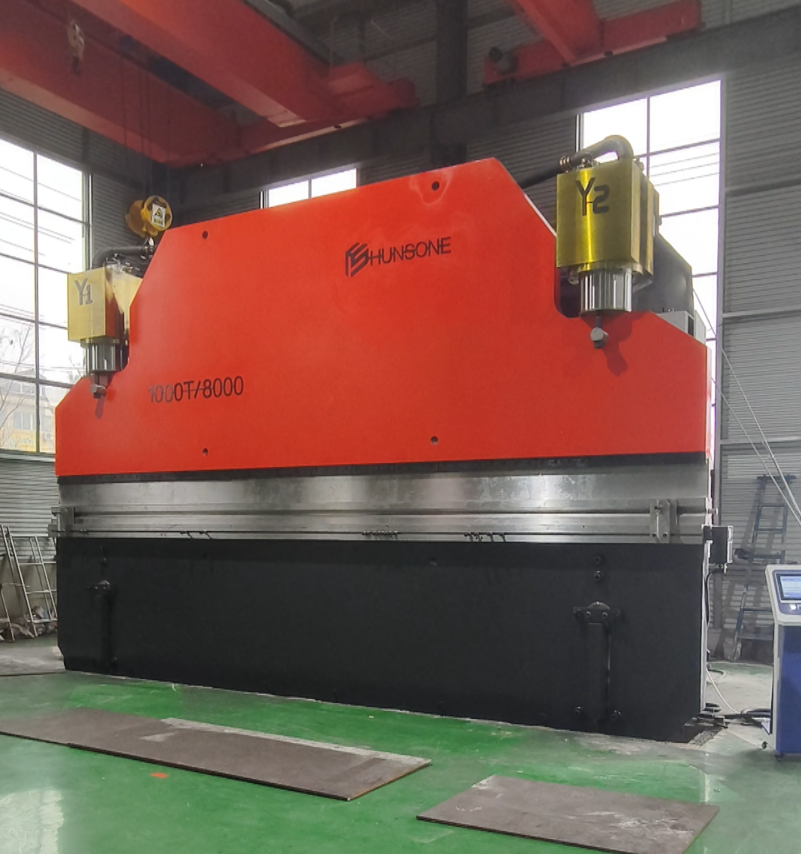
On a giant press brake, the margin between a crisp, repeatable bend and a costly miss is carved out long before the ram ever moves. The frame itself is welded into a single stress-relieved monoblock, then machined in one setup so the bed and uprights share the same reference plane. That sounds simple, but it is the kind of detail that separates machines built for occasional work from those expected to hold angular tolerances across a 10-meter bend. Every bolted joint, every reinforcement rib, and every anchor point is mapped to control deflection under full tonnage, because even a fraction of a millimeter of twist at the center will telegraph straight into the workpiece.
Crowning is where that engineering gets physical. Instead of accepting the natural sag of a long ram and bed, precision brakes use servo-driven wedges or hydraulic cylinders embedded under the die. These adjust their profile constantly, reacting to measured deflection in real time. Paired with optical encoders on both ends of the ram, the control system can hold the punch and die parallel within microns, even when the load shifts from a narrow punch near one side to a full-length die. It is not a static correction; it is an active one that changes with every stroke.
Then there is the backgauge, which on a machine this large has to behave like a precision instrument, not an afterthought. Multiple independently driven fingers ride on hardened linear rails, each with its own servo and glass-scale feedback, so they can position stock without fighting thermal drift. The control software constantly recalculates position based on sheet thickness, bend sequence, and even the slight growth of the metal frame as the hydraulic oil warms up. That level of coordination lets a giant press brake hit the same backgauge position on the hundredth part that it did on the first, shift after shift.
Heavy-Duty Bending Jobs That Only a Giant Press Brake Can Handle
When standard press brakes top out around 300 tons, certain plate work demands far more muscle. Long runs of 1-inch-thick high-strength steel don't flex under moderate tonnage—they require a machine built like a bridge beam. Giant press brakes, often rated above 1,000 tons and spanning 20 feet or more, take on bending jobs that would stall smaller equipment. Think shipyard bulkheads, mining dump truck frames, or pressure vessel shells where a single wrong bend means scrapping a five-figure plate.
The real challenge isn't just force, but control across that massive bed. A 30-foot bend in 1.5-inch plate can deviate by millimeters if the ram isn't perfectly synchronized. That's why heavy fabrication shops rely on giant press brakes with hydraulic crowning and servo-driven backgauges—they hold a consistent angle from one edge to the other without twisting the workpiece. Jobs like wind turbine tower sections or bridge girder flanges demand this level of precision, because welding can't fix a bend that's off by half a degree over 25 feet.
Material springback also behaves differently at this scale. A smaller brake might overbend 3 degrees to compensate, but thick plate snaps back unpredictably unless the operator has deep experience with the specific alloy and die setup. Giant press brakes, with their slower approach speeds and programmable multi-step bending, give shops a fighting chance on one-off structural components. When the job card says "bend 2-inch AR400 plate to 90 degrees over 22 feet," you don't call a standard machine—you clear the floor for the big one.
What to Look for Before Investing in a Giant Press Brake
Before committing to a large press brake, separate your real workload from the spec sheet. Start with the maximum material thickness, bend length, and required tonnage you use daily—then add a safety margin of 20 to 30 percent above that peak. A machine rated far beyond your needs costs more to run and maintain, while an undersized one will force you into multiple hits or compromise bend quality. Pay close attention to frame and ram rigidity, not just tonnage numbers. A welded monolithic structure that limits deflection under full load will hold angle accuracy across a four-meter bend much better than a lighter frame with a higher nominal rating.
After sizing, look at how the brake controls the bend. Automatic crowning, real-time angle measurement, and intuitive offline programming can shorten setup and reduce scrap even with less experienced operators. Confirm that your existing tooling—punches, dies, adapters—will fit without expensive retrofits. Then compare the drive system: servo-electric brakes offer lower idle energy use and quicker warm-up, while hydraulic systems still deliver reliable force for long, heavy production runs. Finally, check the availability of local technicians and critical spare parts. Downtime is more expensive than any price difference, so buy from a supplier who can respond within hours, not weeks.
Maintenance Habits That Preserve a Giant Press Brake's Accuracy
The real enemy of a large press brake isn't the tonnage it handles daily—it's the gritty film that builds up on ram ways and backgauge linear guides. Wiping these surfaces with a low-lint cloth at shift change, then applying a light, high-film-strength way oil, does more for repeatability than most people expect. Pay special attention to the die clamp areas: dried grease mixed with scale will tilt a punch enough to throw bend angles off by half a degree on long parts.
Once a month, cut two identical test strips from the same sheet and bend them at opposite ends of the bed. If the angles differ beyond 0.2 degrees, check the ram parallelism before touching the control settings. Often the fix is a simple shim adjustment under one hydraulic cylinder or a slight gib tightening on the side that has worn more. Keep a log of these readings; a gradual drift tells you which components are wearing and when to schedule corrective work before a job goes bad.
Hydraulic oil is the machine's memory. If it runs hot or dirty, the ram's positioning becomes sluggish and inconsistent. Change filters on the manufacturer's schedule, but also take an oil sample once a quarter—look for rising particle counts or water contamination, which can quietly eat away at valve spools. Keep the reservoir topped and the breather cap clean, and try to maintain a stable shop temperature around the machine; thermal expansion of the frame and oil will shift zero point more than any worn tooling ever will.
Smart Innovations Changing the Game for Giant Press Brakes
Gone are the days when operators had to rely on chalk lines and a feeler gauge to dial in a bend. Modern giant press brakes now come equipped with laser-based angle measurement heads mounted directly to the ram. As soon as the metal begins to yield, these sensors fire hundreds of readings per second, comparing the actual angle against the target in real time. The control system then nudges the ram position mid-stroke, correcting for springback before the part even leaves the tooling. Shops report cutting scrap on thick plate jobs by more than half, simply because the machine no longer waits for a manual check.
Load cells embedded in the bed and strain gauges bonded to the side frames have turned these massive machines into self-aware structures. When a plate is loaded off-center—common with oversized parts—the control unit instantly sees the imbalance and adjusts the crowning system to keep the bend uniform across the full width. The same sensors track fatigue cycles over months of heavy use, flagging small shifts in frame stiffness that indicate a developing crack or loose tie rod. Maintenance becomes proactive, scheduled around actual stress data rather than a calendar, avoiding the kind of sudden failure that can shut a fabrication line for weeks.
Material variation used to be the enemy of repeatable bending. A batch of A36 plate from one mill might behave differently than the last, forcing operators to tweak bend allowances sheet by sheet. New adaptive algorithms pair a small database of past jobs with a quick material identification routine—often using a handheld hardness tester or an integrated surface scanner. The press brake then adjusts its stroke depth and dwell time automatically, compensating for the specific yield strength and grain direction of the incoming blank. The result: a 3-meter-long bend holds the same angle at both ends and in the middle, even when switching between suppliers without touching a single manual offset.
FAQ
The key lies in real-time hydraulic synchronization and active crowning. Multiple cylinders along the beam are monitored by linear encoders, and the control system adjusts pressure in milliseconds to keep the ram perfectly level. Meanwhile, the lower beam under the die is preloaded or shimmed to counteract deflection, so the bend angle stays consistent from one end to the other.
It's rarely just about the force. These machines are built around the workpiece dimensions and the way material resists bending. Wider beds, deeper throats, reinforced frames, and distributed drive systems allow them to handle plate lengths that would cause a conventional press brake to twist or lose parallelism.
Heavy fabrication shops serving shipbuilding, structural steel, mining equipment, pressure vessel manufacturing, and large-scale agricultural machinery come to mind. Any operation that regularly forms thick plates into long, load-bearing profiles benefits from this class of machine.
Yes, provided the tooling and control system are chosen correctly. The machine needs enough reserve tonnage, and the backgauge must be rigid enough to hold position under heavy springback. Modern controllers also allow operators to program overbend angles and dwell times, which are critical for materials like Hardox or S690.
Light curtains are standard, but on giant machines you also see dual-hand controls, laser-based die protection, and physical barriers that prevent anyone from reaching between the tools. Emergency stops are placed at multiple stations because the operator may be far from the main panel while positioning a long plate.
It's absolutely essential. As the ram pushes down, both the upper and lower beams deflect slightly under load. If you don't compensate for that, the middle of the bend will have a different angle than the edges. A good crowning system either uses motorized wedges or hydraulic cylinders under the die to create a reverse curve, restoring straightness.
Look for welded, stress-relieved steel structures with thick side plates and heavily ribbed beds. The frame should be machined after welding and, ideally, after a natural aging period. This reduces internal stress and prevents the machine from gradually losing accuracy over years of cyclic loading.
Most modern giant press brakes use 3D graphical control interfaces. The operator imports a part model or builds the sequence on screen, sets the bend order, and the controller calculates the required backgauge positions, ram depth, and crowning settings. Some systems even simulate the bending sequence to catch collisions before the first part is formed.
Conclusion
Standard press brakes start to fall short when plate thickness climbs past 25 mm or bed length exceeds 6 meters—frame deflection, uneven tonnage distribution, and angular drift become unavoidable. Giant press brakes counter these limits with heavily ribbed welded frames, segmented tooling, and hydraulic crowning that actively compensates for bed flex under load. Real-time angle measurement through laser sensors and multi-axis CNC backgauges maintain ±0.1° repeatability across the entire stroke. This makes them indispensable for shipyard plates, wind tower sections, crane booms, and mining buckets, where high-tensile steel and thick aluminum demand consistent force without overstressing individual cylinders. Instead of multiple forming passes or risky outsourcing, a single setup delivers finished parts.
Choosing one requires more than checking tonnage. Evaluate the bed length-to-thickness ratio, ram parallelism during off-center loading, and thermal drift after sustained operation. Without disciplined maintenance—daily hydraulic fluid and filter checks, monthly backgauge laser alignment, quarterly inspection of gibs and crowning wedges—even the best frame loses accuracy. Operators who treat ram parallelism and backgauge alignment as weekly routines, not annual events, see far fewer angle corrections over the machine's life. Modern machines embed strain gauges directly in the frame, feeding live deflection data to the controller for automatic elastic compensation. Adaptive bending algorithms, tool RFID, and energy-recovery drives reduce trial pieces and scrap while cutting cycle times. These are not merely oversized brakes; they are precision instruments that combine press-level force with coordinate-measuring-machine consistency.
Contact Us
Contact Person: James Chen
Email: [email protected]
Tel/WhatsApp: 86 13770803946
Website: https://www.hunsone.com/