
Karate Hand Guards Manufacturer Guide to Choosing Durable Protection
2026-09-01
Choosing the right karate hand guards can make or break your training—literally. Too often, fighters settle for flimsy padding that wears out after a few hard sparring sessions, leaving knuckles bruised and confidence shaken. But what if your protection could match your intensity? This guide cuts through the marketing noise to reveal what truly makes hand guards durable, from foam density to stitching techniques. As a trusted name in combat gear, PandaWin Sports knows that the right manufacturer isn’t just about price—it’s about craftsmanship that survives every block, punch, and tournament. Ready to stop replacing gear and start upgrading? Let’s break down the essentials.
Why Dense Foam Alone Won’t Keep Knuckles Safe
A dense foam pad feels reassuring because it resists being squashed flat, but that firmness creates a false sense of security. When your fist hits a target, the foam has to slow the impact over a few milliseconds. Dense foam does not absorb that energy gradually; it passes the peak force through to the knuckles almost unchanged. Instead of spreading the load across the back of the hand, it concentrates pressure on the points that touch first, usually the second and third knuckles. That is why you can still end up with bruised skin and sore joints even when the glove looks thick.
Another problem is that dense foam compresses unevenly and loses its shape after repeated strikes. It hardens in some areas while leaving soft gaps in others, so the knuckles no longer sit against a consistent cushion. The material also does not contour to the natural curve of a closed fist, leaving small air pockets right where impact is highest. Without a softer layer closer to the skin and a firmer layer further out, the glove cannot manage both shock absorption and structural support. A single dense foam slab simply is not enough to keep the knuckles safe over hundreds of punches.
The First Stitch to Fail on Most Karate Hand Guards
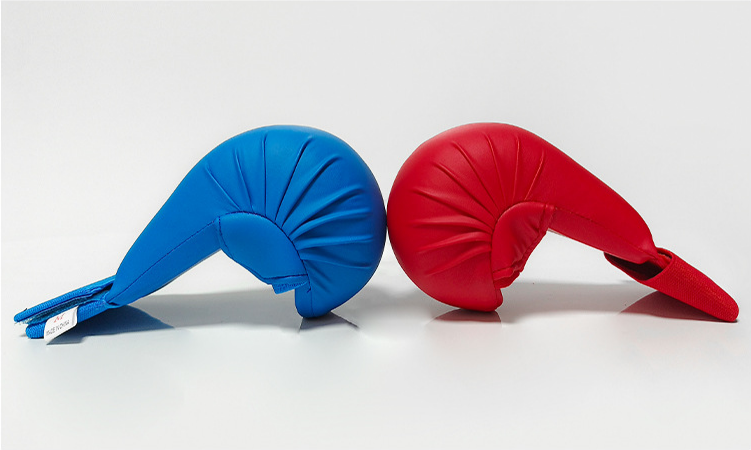
The first stitch to fail on most karate hand guards is not the obvious one across the padded knuckles. It’s the short, curved seam running along the base of the thumb where the palm panel and the backhand panel meet. Every time you close your fist and throw a hook or a straight punch, that seam absorbs a sideways shear load that most other stitches never see.
What makes it fail early is how the panels are usually assembled. The ends get a few backstitches, but the middle of that thumb-base seam is often a single run of thread with no reinforcement. Once one loop snaps from repeated twisting, the damage unzips along the line before the surrounding fabric shows real wear. You’ll notice a small gap opening near the webbing of the thumb long before the glove itself tears.
If you catch it early, repair that seam with waxed nylon or polyester thread and add a strip of bias tape on the inside. That shifts the stress away from the thread holes and can double the life of the guard. Replacing the seam after it opens more than a few millimeters usually means the foam backing has already started to deform, so early stitching is the only real fix.
Getting a Snug Fit Without Losing Wrist Mobility
A common trade-off people accept is that a tight fit around the wrist automatically limits how far you can bend or rotate your hand. That assumption usually comes from ill-fitting bands, cuffs, or closures that dig in at the edges instead of distributing pressure evenly. The trick is to look for designs that taper slightly toward the wrist bone and leave a small gap at the flex point. Materials with a bit of four-way stretch, like woven elastane blends or perforated neoprene, can hold everything in place without acting like a cast.
Another overlooked factor is how the closure sits. A buckle or strap placed directly over the tendons on the underside of the wrist will pinch whenever you extend your hand. Shifting that closure to the outer edge, or switching to a low-profile magnetic or hook-and-loop system that spreads tension across a wider area, makes a noticeable difference. You still get the security of a snug fit, but the joint keeps its full range of motion for typing, lifting, or swinging a racket.
If you are adjusting an existing item rather than shopping for a new one, try wearing it slightly higher on the forearm during activities that demand a lot of wrist articulation. That small shift moves the compression away from the narrowest part of the joint. It is a simple fix, but it often resolves the pinch without loosening the fit to the point where things slide around.
How Sweat and Heat Quietly Break Down Padding
Every time you train hard, sweat seeps past the outer shell and finds its way into the foam or fiber layers. The moisture alone doesn’t cause instant damage, but it stays trapped against the padding, softening adhesives and allowing salts to settle into the microscopic gaps. Over weeks, that damp environment encourages bacterial growth that eats away at organic binders, while the repeated cycle of heating and cooling makes the material lose its rebound.
Direct sunlight or body heat can push internal temperatures high enough to accelerate chemical breakdown. Polymers in the padding become more pliable, and when pressed under weight, they deform and don’t spring back the same way. The heat also evaporates sweat unevenly, leaving concentrated salt crystals that abrade the cell walls from inside. This is why gear that looks fine on the outside can feel flat and unsupportive after a single hot season.
What Real Sparring Reveals About Durability Labels
Step into any gym and you'll hear the same story: a fighter's chin is either granite or glass, a body either iron or paper. These durability labels get tossed around like they're set in stone, but real sparring has a way of shattering that myth faster than a well-timed uppercut. Put two people in the ring with headgear and sixteen-ounce gloves, and suddenly the guy who never gets dropped in pad work is wobbling from a jab he didn't see coming. The label doesn't survive first contact.
What actually shows up under live fire is far messier. Some fighters absorb flush hooks but crumble from a stiff body shot. Others eat knees to the ribs all day yet get rattled by a grazing cross. Sparring reveals that durability isn't a single setting that someone is born with or without. It's a moving target shaped by fatigue, timing, foot placement, and whether the strike lands during an exhale or a breath in. The fighter who looks unbreakable in round one might turn brittle by round five after eating thirty unanswered shots.
Coaches who watch hundreds of sparring rounds learn to ignore the gym-floor labels entirely. They start seeing durability as a skill: how well you roll with shots, manage distance after getting hit, and recover between exchanges. A skinny kid with good head movement and late-round composure can prove far harder to finish than the muscled slugger everyone calls a tank. Real sparring strips away the mythology and leaves something more useful: a honest read on how a person handles getting hurt when no one's keeping score.
Signs Your Hand Guards Need Retirement, Not Repair
Plastic hand guards that have spent a couple of seasons in direct sun often start to show a chalky, faded surface. Run a fingernail across the material and you might feel tiny cracks radiating from the mounting holes. At that point the polymer has lost its flexibility; a hard hit will make it shatter into sharp pieces instead of bending and springing back.
Another sign is hardware that won't stay tight no matter what you do. If you've already swapped in longer bolts or added threadlocker and the guard still rattles loose after a short ride, the threaded inserts or the surrounding plastic have likely wallowed out. Cranking down harder only chews up what's left, and next time the bike tips over, the guard can tear free in your hand.
Look at the overall shape too. A guard that's been bent back after a crash but now sits closer to the brake lever or touches the grip at full lock isn't worth heating and bending back into place. That kind of repair weakens the material along the original crease, and it will fold there again with far less force. Retire it before it becomes a hazard.
FAQ
For frequent sparring, closed-cell EVA foam with a dense outer layer tends to hold its shape far longer than softer open-cell padding. Look for a manufacturer that uses reinforced gel inserts over the knuckles and a hardy synthetic leather shell, because those two details stop most mid-season replacements. Stay wary of thin fabric backing, which wears through after a few months of sweaty training.
Ask the manufacturer for a cutaway sample or a high-resolution close-up of the seams. You want double or triple stitching along stress points, especially where the thumb meets the palm. If the thread looks thin or the stitches are spaced wide apart, the guard will likely split when a student blocks a hard kick. A simple pull test on the sample can also reveal weak bonding between layers.
Not necessarily. Extra thickness can make hands clumsy and interfere with proper fist formation, which leads to wrist strain. For youth classes, around 10-12 mm of dense foam usually balances protection and mobility. Adults hitting heavy bags or doing full-contact drills may need 15 mm or more, but the foam density matters more than the raw thickness.
Look for a pre-curved shape that follows a relaxed fist instead of forcing the fingers flat. A breathable mesh palm or perforated leather keeps sweat from building up and making the guard slip. Some manufacturers add a terry cloth thumb panel for wiping the face, which is a small touch that keeps students from adjusting their gear constantly.
Ask for a compression test video or the foam's density rating in kilograms per cubic meter. Cheap foam often has a density below 60 kg/m³ and flattens permanently after a few hard impacts. You can also request a small sample swatch and pinch it hard—if it stays dented for more than a few seconds, the rebound is poor and the guards won't last.
In a dojo with five or more classes per week, entry-level guards typically need replacing every six to nine months. Mid-range options with reinforced stress points can last a year or more. Watch for telltale signs like flattened knuckle padding, cracked outer shells, or loose elastic straps, and replace pairs before students start complaining about sore hands.
Custom sizing has a real payoff, especially for kids and adults with unusually narrow or wide palms. A well-fitted guard keeps the padding aligned over the knuckles during impact instead of sliding sideways. Many manufacturers offer small tweaks like adjustable wrist closures or half sizes without a huge cost increase, which can cut down on hand injuries from loose gear.
The smart move is to look at the cost per training hour rather than the upfront price. An $18 pair that survives 300 classes costs less per session than a $10 pair that falls apart after 100. Ask the manufacturer about their warranty or replacement policy, and if they hesitate to answer, treat that as a red flag about how they stand behind the product.
Conclusion
Dense foam padding might look reassuring in product photos, but real knuckle protection demands layered engineering. Single-slab foam compresses too quickly under repeated impact, leaving the metacarpals exposed after just a few hard sparring sessions. The first point of failure is rarely the foam itself—it's the stitching where the finger loops meet the back panel. Pull-test any pair and you'll notice tension concentrates there, causing seam tears long before the padding degrades. Manufacturers who reinforce that junction with double-needle bar tacking and place stress-relief notches in the pattern extend usable life dramatically.
A snug fit should never mean a stiff wrist. Look for designs that use a pre-curved palm bar and a short neoprene cuff instead of a full wrap; this keeps the guard from shifting during hooks while allowing the wrist to flex naturally for open-hand techniques. Sweat and heat are silent destroyers: closed-cell foams trap moisture against the liner, accelerating hydrolysis and causing the pad to crumble from the inside. Sparring exposes the gap between lab-tested durability and real-world abuse—edge strikes, repeated throws, and washing machine cycles. When the outer shell shows deep creases that don't rebound, or the finger loops lose elasticity and slide past the knuckles, it's time to retire the guards. Repairing torn foam or re-stitching a blown seam only masks structural fatigue; a well-made pair should be replaced before a fist injury forces the decision.
Contact Us
Contact Person: Fei Xu
Email: [email protected]
Tel/WhatsApp: +8618631245578
Website: https://www.pandawinsports.com/