
OEM Electric Telescopic Mast Systems Built for Reliable Field Deployments
2026-11-23
Field deployments have a way of exposing weak engineering before anything else does. That is why the most capable OEM electric telescopic mast systems are built around a single idea: predictable performance when the location, weather, and schedule are not. At Homall Industry Limited, that means turning specific operational requirements into rugged, repeatable mast designs rather than asking teams to adapt their mission to a catalog. The result is a system that goes up quickly, stays stable under load, and keeps the focus where it belongs—on the job, not the hardware.
Unstable Generator Power and What It Does to Mast Drive Electronics
A generator that can't hold a steady voltage does more than make the lights flicker. The mast drive electronics rely on clean, predictable DC power to keep the lift motors, limit switches, and control boards working in sync. When the generator's output swings under load, the rectified bus voltage dips and spikes erratically. Low voltage triggers under-voltage lockouts and brownout resets, while the spikes push transient energy into sensitive gate-drive circuits. Over time this repeated stress breaks down capacitors, corrupts stored position data, and can leave the mast stuck mid-travel with no clear fault code.
The less obvious failure happens when the generator's frequency drifts. Most mast controllers count AC cycles to time soft-start ramps and motor braking. A governor that hunts or lags lets the frequency wander, so the controller's timing assumptions collapse. You may notice the mast accelerates harshly, overshoots a limit, or jerks during deceleration. Technicians often chase mechanical binding or bad encoders, but the root cause is simply that the controller is receiving a messy power signature it was never designed to interpret.
What makes this tricky to diagnose is that the generator may test fine under no load or with a resistive load bank. The problem only appears under the dynamic load of a mast lifting a full platform. The drive's regenerative braking can also push current back toward the generator, confusing its voltage regulator. Running the generator slightly under its rated continuous output, checking the automatic voltage regulator's response time, and adding surge suppression close to the drive input are practical steps that prevent most of these failures before they damage the electronics.
How Telescopic Sections Handle Side Loads After Repeated Deployments
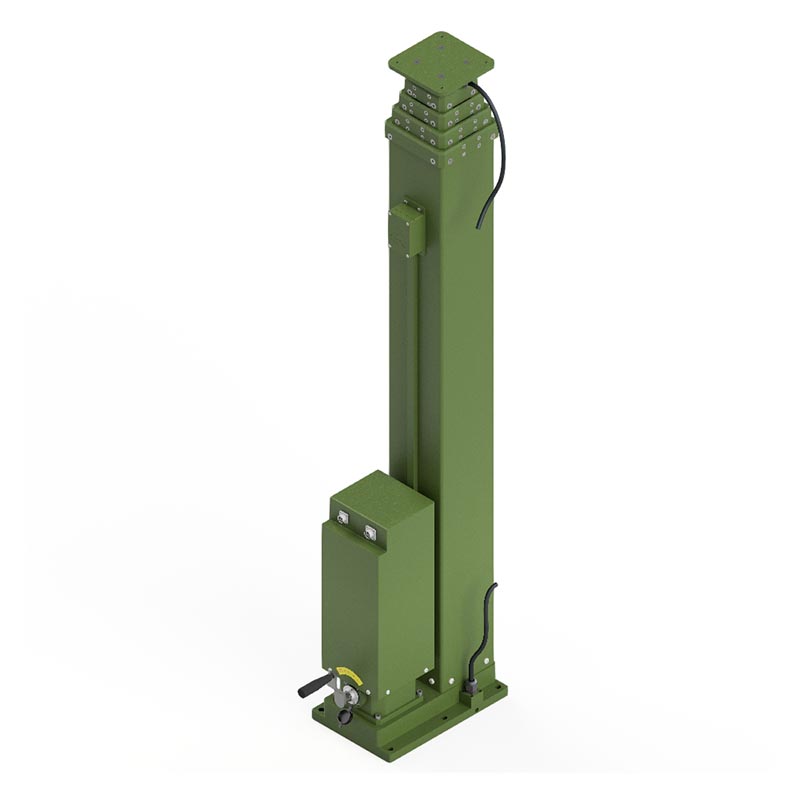
After enough cycles, the real story shows up in the lock interfaces, not the tube walls. Every extension and retraction burnishes the overlapping surfaces slightly; that creates clearance. Under a side load, the nested sections no longer share the load evenly, so the outermost joints take a disproportionate share. Engineers usually address this with wedge-type locks or adjustable gibs that can be re-tightened as the clearances open up.
Repeated deployments also shift how friction behaves. The first few cycles might feel stiff because anodizing or coating still has its original roughness. Later, once that surface has bedded in, the resistance drops, but the section can deflect further before the locks engage. Some designs rely on spring-loaded or tapered keys that compensate for that wear automatically; others need a field adjustment to restore the original lateral stiffness.
In practice, telescopic assemblies that handle side loads well after repeated deployments tend to use shorter overlap lengths and replaceable wear pads. Rather than trying to machine every sliding interface to a perfect fit, designers leave deliberate bearing points that can be swapped or shimmed. That keeps the maintenance simple and prevents the whole assembly from turning into a loose, rattling stack when it is fully extended under load.
Coastal Weather, Corroded Seals, and the Masts That Keep Moving
Salt haze settles into every fitting around here. It doesn’t arrive as a dramatic storm; it builds in the thin film of dew that forms before sunrise and gets pushed under the rubber rings by a northeast breeze. Within a season, the seal that looked solid at the dock will show pale crust around its edge, and when you press a thumbnail into it, the surface gives way with a dry crack instead of a rebound.
The masts keep moving because the boat never really rests. Swells roll through the harbor, the hull flexes at the chainplates, and each gust torques the spar a few degrees before it swings back. That repeated motion works on the boot and the partners like a slow file. A leak rarely starts at the obvious tear; it starts as a polished groove where the anodizing has been rubbed through, letting water track down inside the cabin long before the sky opens.
What works is unglamorous: wipe the seal faces when the wind drops, replace anything that has lost its give, and accept that some fixtures will need attention every spring. Coastal weather doesn’t reward shortcuts. It rewards watching how the light hits the mast step in the morning and noticing when the shadow moves differently than it did the week before.
Choosing Between Speed and Control on a Fully Extended Mast
When the mast is fully extended, the machine's center of gravity shifts upward and forward, so every small input at the controls gets amplified at the load. An operator who tries to move too quickly through that last stretch often ends up correcting sway or stopping short of the rack. The real skill is reading how the mast flexes and letting the hydraulics settle before making another adjustment.
Speed still has a place, but it has to be front-loaded. Cover ground quickly while the mast is low and retracted, then ease into the final lift with smaller lever inputs and a slower engine or drive setting. Many experienced operators treat the upper portion of the lift as a positioning task rather than a travel task, and that shift in mindset keeps both the load and the surrounding crew safer.
Machine setup matters too. Adjusting flow rates, using creep mode, or switching to a finer control pattern can make the extended mast feel less twitchy. When the equipment supports that adjustment, it removes some of the guesswork and lets the operator hold a steady line without constantly fighting the controls.
Manual Override Paths When the Network Goes Down
Losing network connectivity does not have to mean losing control of critical equipment. Many installations keep a set of hardwired override stations or local bypass switches that let operators issue commands without any data link. These paths are deliberately kept separate from the main control network, often using simple relay logic or direct analog signaling, so a fiber cut or switch failure cannot disable them.
The practical value of these routes shows up in situations where remote monitoring drops but machinery still needs to move, valves must close, or lighting and climate systems require manual intervention. Rather than waiting for IT to restore access, personnel can follow a short sequence at the equipment panel: confirm the failure, switch the selector from automatic to local, and then run the necessary action with mechanical or electrical controls. Some sites also place printed step-by-step cards near these panels because relying on memory during an outage is risky.
What makes one manual override design better than another is usually not the hardware itself, but the clarity of the path. Color-coded switches, simple labels that avoid jargon, and regular drills help staff act quickly under pressure. A bypass that is technically present but hidden in a locked cabinet, or documented only in a rarely opened manual, offers little comfort when the network falls over. Good overrides are visible, tested, and treated as part of routine operation rather than an afterthought.
Field Maintenance Checks That Catch Mast Wear Before It Fails
Most mast wear starts small enough to hide during a quick walkaround, but a few deliberate checks will expose it long before a failure leaves equipment down. Run your hand along the inner channels where the carriage rollers travel; a subtle ridge or a polished groove tells you the hardening layer is thinning, even if the naked eye sees nothing alarming. Pay attention to the chain anchor points at the top and bottom of the mast, since loose hardware or slight elongation there changes load distribution and accelerates uneven wear. If you catch the mast making a dry scraping sound during lift or spotting fine metal dust collecting near the roller paths after a shift, stop and measure the rail thickness instead of assuming the noise will go away.
A simple set of feeler gauges does more than any visual guess. Slide the gauge between the roller and the mast rail at three heights while the forks are loaded near capacity; a gap that opens wider at mid-lift or changes from side to side means the rollers are no longer holding the carriage square. Write those numbers down. Comparing them month over month gives you a wear curve that predicts when the mast will reach the manufacturer's discard limit, so you can schedule the rebuild during a planned shutdown instead of waiting for a cracked flange or seized roller to force the issue.
Also look for the less obvious signs that maintenance teams often skip: fretting rust around bolt holes, step wear where the mast sections overlap, and chain links that sit slightly twisted in the sheave pocket. Each one points to a mast that is flexing or shifting under load, and that movement accelerates damage everywhere else. When you document these conditions along with the gauge readings, you turn a routine inspection into an early warning system. The goal isn't to find a problem that's already happened, but to know the mast is wearing past its safe margin two or three service intervals before it breaks.
FAQ
Most units reach full extension in under two minutes, depending on the model and payload. The drive mechanism handles the lifting sequence automatically once the operator confirms the site is level and clear.
Common integrations include pan-tilt cameras, antennas, lighting arrays, and meteorological sensors. Payload capacity varies by mast diameter and extended height, but many of our OEM builds are configured for 50 to 150 kg at full extension.
Each section uses a sealed collar design with wiper rings to keep debris out during retraction. Corrosion-resistant finishes and protected cable routings add a second layer of defense in wet or dusty environments.
Yes, that is the main advantage of the OEM approach. Mounting plates, cable exits, locking positions, and control interfaces can be adapted to the customer's platform rather than forcing a vehicle redesign.
A mechanical brake holds the sections in place. Manual override points allow controlled retraction with a hand crank or drill adapter, so the mast can be lowered without hydraulic or electric power.
Operators can set a maximum extended height through the controller. Optional ultrasonic or laser proximity sensors provide an automatic stop when an object is detected above the payload.
The controls are typically reduced to a key switch, an up/down toggle, and a status display. Training usually covers safety interlocks and manual procedures in under half a day.
Conclusion
Field power is rarely clean, and a telescopic mast that depends on sensitive drive electronics has to tolerate voltage swings without burning boards or losing position data. Good OEM designs separate the motor supply from logic-level circuits and add filtering where it actually matters, rather than assuming a generator will behave. Repeated side loading is just as unforgiving: telescopic sections wear at their guide surfaces and locking points, so tolerance control and serviceable wear strips make the difference between a mast that still tracks straight after months of use and one that binds under wind. Coastal conditions add another layer, with salt-laden air working into seals and connectors. Masts built for those environments use sealed junction points and corrosion-resistant hardware, and the seals are placed where they can be inspected and replaced without tearing the whole assembly down.
Full extension changes the handling equation. A fast mast that overshoots or jerks at the top is hard to control, especially when payloads are sensitive, so OEM systems often pair soft-start drives with adjustable creep speeds rather than forcing an all-or-nothing choice between speed and precision. If the network drops, manual override becomes the fallback that keeps operations moving; a hand crank or local pendant should work without relying on remote software. Field checks tie all of this together. Routine inspection of cables, seal condition, section alignment, and drive current trends catches small changes before they become failures, and that is what separates a mast that survives a deployment from one that strands equipment at height. These details, designed in from the start, make electric telescopic masts dependable when field conditions are not forgiving.
Contact Us
Contact Person: Ryan
Email: [email protected]
Tel/WhatsApp: +85259582726
Website: https://www.robomast.com/