
Warehouse Ceiling Fans Company: Expert Tips to Pick the Best Industrial Cooling Solution
2026-07-14
Choosing the right industrial ceiling fan for your warehouse isn't just about moving air—it's about optimizing comfort, energy efficiency, and safety. With so many options flooding the market, facility managers often overlook critical factors that can make or break a cooling solution. At VINDUSFAN, we've seen how the right decision transforms work environments, and the wrong one leads to wasted budget. This guide distills hard-won insights to help you pick a system that truly delivers.
Why Industrial Ceiling Fans Beat Standard Cooling Methods Every Time
Standard cooling methods force you to choose between comfort and cost. Portable fans barely stir the air, while air conditioning gulps energy and still leaves hot and cold pockets across the room. Industrial ceiling fans, by contrast, move massive volumes of air slowly and evenly, creating a floor-to-ceiling cooling effect that feels natural, not mechanical. That smooth, consistent airflow is what actually makes people feel cooler, without the drafts, noise, or sky-high electric bills.
What really separates industrial fans from the usual fixes is how they treat the space itself. Instead of just blowing air past a few workstations, they mix the entire room’s air, breaking up heat layers so the temperature evens out from wall to wall. In high-bay warehouses, gyms, or workshops, that means the thermostat can be set several degrees higher without anyone noticing a difference—except in the monthly savings. No other cooling approach accomplishes that so simply.
Durability also plays a huge part. A box fan on the floor or a wall-mounted oscillating unit gets knocked around and quits within a season. Industrial ceiling fans are built for constant use in tough environments, often lasting decades with minimal upkeep. They don't clutter floor space, they don't collect shop debris, and they don't need to be relocated every time you rearrange the layout. That long-term, set-and-forget reliability is the final piece that makes a traditional cooling method feel like a compromise.
Assessing Your Warehouse Layout for Maximum Airflow Coverage
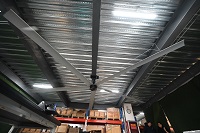
Warehouse airflow begins with understanding how air moves through the space. Unlike a simple room, a warehouse has high ceilings, tall racking, and large machinery that can block or redirect airflow. Start by mapping out the main areas: receiving, storage, packing, and shipping. Notice where air feels stagnant or where temperatures tend to fluctuate. These are often signs that the existing layout is disrupting the natural flow of air.
The placement of racking and shelving plays a crucial role in airflow coverage. Rows that are too tightly packed or aligned directly against the airflow direction create dead spots where hot or humid air can accumulate. Consider adjusting row orientation to be parallel with the dominant air currents, or introduce cross-aisles that allow air to move laterally. Even slight changes to rack height or depth can improve circulation without reducing storage capacity.
Don't overlook the impact of loading docks, doors, and ventilation points. Frequent opening of dock doors creates pressure differences that can pull air from one end of the warehouse to the other. Position high-activity zones closer to these natural air exchange points, and use fans strategically to guide cool air toward heat-producing equipment and personnel areas. A layout that collaborates with natural air patterns and mechanical systems will achieve better temperature control and energy efficiency.
The Overlooked Factor That Decides Fan Efficiency: Blade Design
Most people fixate on motor power or RPM specs when picking a fan, yet the real workhorse sits right in the airflow— the blades themselves. A fan's ability to move air quietly and efficiently hinges on subtleties in blade curvature, pitch angle, and surface finish that rarely make the spec sheet. You can have two identical motors with different blade sets, and the one with thoughtfully sculpted blades will easily outperform, sometimes cutting energy use by a third while pushing more air.
The magic lies in how blades interact with air molecules. Swept tips inspired by owl wings can dramatically hush the whooshing noise that plagues cheap fans, while a variable pitch along the length keeps airflow smooth instead of churning turbulent. Even the trailing edge—often a sharp, thin line—can be scalloped or serrated to break up vortex shedding, much like a humpback whale’s flipper. These aren’t gimmicks; they’re biological solutions that engineers are finally adapting to replace brute-force spinning.
What makes blade design so easy to overlook is that it’s invisible when done right. A poorly designed blade fights itself, creating backflow and cavitation-like dead zones right behind the hub, while a well-shaped blade accelerates air with minimal drag. The difference shows up in your power bill and comfort level, yet it’s hidden under a plastic guard. Next time you listen to a fan that hums rather than roars, know it’s not just a better motor—it’s blades that deserve most of the credit.
How High Ceilings, Heat Load, and Humidity Change Your Fan Choice
When dealing with high ceilings, your fan needs to move enough air to make a noticeable difference. Standard ceiling fans are rated for rooms with 8-foot ceilings, but taller spaces require models with higher CFM ratings and wider blade spans. Look for fans labeled for great rooms or commercial use; they often have blade pitches that push air further, preventing it from getting lost before reaching the occupied level.
Heat load from machinery, lighting, or sunlight can create thermal stratification, leaving hot air trapped at the top while the floor stays cold. A well-placed ceiling fan breaks up these layers, recirculating warm air downward in winter and creating a cooling breeze in summer. In spaces with concentrated heat sources, variable speed controls let you ramp up airflow precisely where it’s needed without wasting energy.
Humidity adds another layer of complexity. In damp conditions, the breeze from a fan accelerates moisture evaporation from your skin, making the space feel cooler even at higher thermostat settings. For consistently humid environments, choose fans with moisture-resistant finishes and sealed motors to prevent corrosion. Pairing your fan with a dehumidifier can further reduce the actual moisture content, turning a muggy room into a comfortable retreat.
Motor Quality and Durability: The Silent Cost Saver
When evaluating the long-term value of a motor, it's the hidden engineering that truly matters. Premium motors often feature improved insulation systems and precision-balanced rotors, which drastically reduce internal stress. These seemingly minor details prevent sudden breakdowns, keeping maintenance interventions rare and unplanned downtime virtually nonexistent.
The real durability test comes from withstanding harsh operating environments—dust, moisture, and temperature swings all take their toll. Motors built with high-grade bearings and corrosion-resistant coatings handle these challenges without faltering. They maintain steady efficiency over years of service, avoiding the gradual performance decay that forces frequent replacements.
Think of motor quality as a silent investment. An upfront cost difference often pays back manifold through lower energy bills and the elimination of repeated repair cycles. Over a decade, the total cost of ownership tilts sharply in favor of a robust, carefully crafted motor—making it the quietest yet most impactful cost saver in any operation.
Installation Pitfalls to Avoid for Long-Term Performance
Skipping the load calculation is one of the fastest ways to undermine a system’s long-term reliability. It’s tempting to rely on rule-of-thumb sizing, but even a slightly oversized or undersized unit will cycle on and off too frequently, driving up wear on compressors and blowers while leaving humidity unchecked. Take the time to run a proper Manual J or equivalent heat gain/loss analysis; the numbers rarely lie, and the payoff shows up years later in steadier run times and fewer surprise failures.
Duct leaks and sloppy connections often hide in plain sight until the first utility bill arrives. A rushed install that leaves seams unsealed or flex duct kinked can bleed 20 to 30 percent of conditioned air into unconditioned spaces. Beyond the energy waste, the equipment has to work harder to maintain set points, which shortens its service life. Paying attention to mastic, proper support, and the right fasteners isn’t glamorous, but it keeps performance from degrading right out of the gate.
Ignoring airflow and refrigerant charge precision might seem harmless in the short term, yet it sets the stage for a slow decline. Even a slight undercharge can starve the evaporator coil, causing it to ice up and rob the compressor of cooling, while an overcharge stresses the entire refrigerant circuit. Combine that with a filter grille that’s too restrictive or return ductwork that’s undersized, and you’ve baked in a lifetime of efficiency losses. The fix is straightforward: measure static pressure, dial in the charge to manufacturer specs, and verify airflow before walking away. It’s the kind of diligence that keeps a system running quietly for a decade instead of limping along after three years.
FAQ
A lot of facilities only look at the fan diameter or price without considering ceiling height, layout, or airflow pattern. This often leads to dead spots, poor air mixing, or fans that are simply too weak for the space.
If your ceilings are 15 feet or higher and you need air movement across a wide area for cooling or destratification, HVLS fans are almost always the better pick. They move massive columns of air gently and quietly, while high-speed fans tend to create drafts and noise without covering the same floor area efficiently.
It’s not just about how many blades a fan has — the shape, pitch, and airfoil design determine how much air gets moved per watt. A well-engineered blade profile can outperform a fan with more blades that’s poorly designed, making energy efficiency the real differentiator.
Essential. Without speed control, you’re stuck with a one-size-fits-all setting that wastes energy in mild weather or fails to deliver enough cooling on hot days. Variable speed lets you fine-tune airflow seasonally and even integrate with building management systems.
Go for direct-drive motors with sealed housings and high IP ratings — they eliminate gearbox maintenance and stand up to dust, moisture, and temperature swings. Torque-to-speed characteristics matter too; you want a motor that can deliver consistent performance at low RPMs without overheating.
Absolutely. By running fans in reverse at low speed, you push warm air that’s trapped at the ceiling back down to the floor. This destratification can cut heating expenses by 20–30% in many warehouses, often making the fans pay for themselves within a couple of years.
Skip the generic square-foot-per-fan rule. Work with a supplier who uses computational fluid dynamics modeling or at least does a site walk to map out racking, columns, and work zones. Overlapping coverage patterns prevent gaps and make sure every aisle gets adequate airflow.
Conclusion
Choosing the right industrial ceiling fan for your warehouse isn't just about moving air—it's about engineering a complete cooling solution that adapts to your specific space. Unlike standard floor fans or spot coolers, modern high-volume, low-speed (HVLS) fans create a massive column of air that circulates throughout the entire facility, balancing temperatures and eliminating hot spots. The key is to evaluate your layout precisely: consider aisle widths, racking configurations, and any obstructions that could disrupt airflow. A well-planned fan layout, often overlapping coverage areas by 20–30%, ensures no corner is left stagnant. Meanwhile, blade design plays a surprisingly pivotal role—airfoil-shaped blades with winglets can deliver up to 40% more coverage than flat blades, reducing energy costs while maintaining comfort. You’ll also need to account for ceiling height, heat load from machinery, and ambient humidity, as these factors dictate the diameter and speed settings required. In humid environments, for instance, a fan’s gentle breeze enhances evaporative cooling, making workers feel up to 10°F cooler without lowering the actual temperature.
Beyond performance specs, investing in a fan with a premium motor—look for gearless direct-drive systems with sealed bearings—pays off through years of maintenance-free operation and silent reliability, slashing long-term ownership costs. Yet even the best fan will underperform if installed incorrectly. Common pitfalls include mounting too close to ceilings, which chokes intake airflow, or placing fans too high above work zones, reducing felt air speed. Always follow manufacturer guidelines for hang height and spacing, and secure mounts to structural steel, not just roof decking, to prevent vibration and premature wear. A professional installation might cost more upfront but prevents costly retrofits later. By weighing these interconnected factors—from blade geometry to motor integrity and precise placement—you'll invest in a system that not only cools efficiently but also boosts productivity and morale year-round, making it a strategic asset rather than a mere appliance.
Contact Us
Contact Person: Michael Danielsson
Email: [email protected]
Tel/WhatsApp: +1 951 565 7769
Website: https://www.vindusfans.com